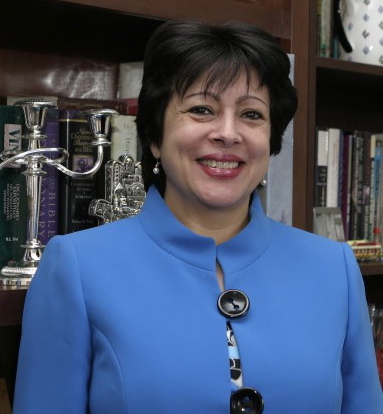
Mercedes Lopez-Miranda
Summary: Mercedes López-Miranda is a pastor and leader of the women's ministry at the León de Judá Congregation in Boston. She has been married for almost three decades and has two daughters, a son-in-law, and grandchildren. Her main motivation is to glorify God and be used as an instrument of edification and restoration.
Mercedes López-Miranda was born and lived in Puerto Rico until 1982, when she moved to Boston to pursue graduate studies. Since 1984, she has pastored the León de Judá Congregation with her husband, Dr. Roberto Miranda, who died in 2022. For the past 20 years, she has led the congregation's women's ministry, which hosts an annual regional retreat. Meche also heads CLJ's counseling ministry.
Meche writes: "My main motivation is to glorify God in everything I do and my greatest passion is to be used by Him as an instrument of edification and restoration. I am deeply grateful to God for the blessing of almost three decades of marriage, of being the mother of two daughters and a son-in-law and the opportunity to enjoy my little grandchildren".
Publications
Silence and Stillness—endangered Arts
The pace of modern life turns overwork, constant activity, information, and noise into apparent virtues, even though they ultimately exhaust us, throw us off balance, and rob us of sleep, joy, and the ability to enjoy other people. Time and energy are valuable but limited resources; therefore, we must examine our habits, our use of social media and other media, and the distractions that invade our physical, mental, and spiritual space. Working, keeping busy, and making use of communication media are beneficial, but we must not turn activity into an idol or live trapped by anxiety. Let us cultivate silence and rest in God, even as we resist deeply rooted habits: there we will be able to hear him, receive wise guidance, and be renewed with fresh strength.
Celebrating the Day of True Love
Although outward expressions of love change according to the era, culture, and personal experiences, its essence remains unchanged. Love is not a human invention but a gift from God, who is love. Therefore, we must love God with our whole being and our neighbor as ourselves, rejecting the world’s easy, superficial, and conditional version of love. First Corinthians 13 allows us to examine the way we love: true love is patient, kind, humble, just, persevering, and keeps no record of wrongs. Recognizing our shortcomings should not discourage us but lead us to give thanks for the Father’s perfect love and ask Him to define and transform our everyday love.
Visionary Motherhood - Raising a Generation of Samuels
A visionary motherhood or fatherhood is a crucial and complex task that cannot be carried out alone. It requires collaboration with God, and our mission is to give our children a living example in behavior and word of what it means to love and obey God. To have a visionary maternity or paternity, one must first acknowledge that motherhood comes from God and dedicate their children to Him. Prayer is also fundamental to a visionary motherhood, as it builds the foundation of our children's lives and allows us to supernaturally influence them. By pouring out our souls before the Lord, we can receive peace and hear God's voice for our children's character and relationship with Him.
The story of Hannah in the Bible teaches us about visionary motherhood. As mothers or fathers, we must recognize that our children are a precious possession from God and cover them with intentional prayer. We must also seek the healing of our own character and recognize that we are powerful tools in God's hands. It is important to confront our own "Penina," or rival, and use our time intentionally to disciple our children in the ways of the Lord. By doing so, we plant eternity in our children and leave a legacy of character that is priceless.
We Are the Mentors of Our Children
The speaker has worked with young children for almost 40 years, specializing in motor development and working with children with developmental disabilities. They believe that children are the greatest resources we have and that parents are the main factor in a child's success. As parents, it is important to invest in children and nurture them to reach their potential, especially in the spiritual realm. The speaker gives an example of how a young child can understand deep biblical concepts and emphasizes the importance of being intentional and patient in raising children, even in the midst of many responsibilities. They also caution against the harmful effects of mobile gadgets on small children and encourage parents to discover their children's unique qualities and interests.
As parents, we have to know our children personally, discover their interests, and help them build on them. We have to share the joy of exploration and discovery with them, accompany them in mastering skills, and provide them with an emotional and spiritual environment that makes it easier for them to imitate us. By doing these things, we can produce great fruit in our children's lives, solidify our bond of love, and provide a solid foundation for them to try new things and succeed in future opportunities and challenges. Our prayer should be to see eternity in each child and minister to their lives with all the courage and passion we have, knowing that it will not be in vain and everything will be for God's glory.
Couples Interview
The first episode of CLJ presents, a new program by Congregación León de Judá, features an interview with a couple, Marino and Isabel López, who have been married for 11 years and have faced challenges in their marriage. They share how they found the church during a difficult time and received counseling from mature believers in the congregation. They emphasize the importance of forgiveness, reconciliation, and communication in relationships. Despite coming from different spiritual traditions, they felt welcomed and loved by the congregation. The hosts, Pastor Roberto and Jonathan, highlight the role of marriage in the growth and perfection of believers and the power of the Gospel to transform difficult situations.
In this transcript, Jonathan and Roberto interview two married couples from their church - Marino and Isabel López and José León and Carolina Barrutia. The couples share their experiences of marriage, including their struggles and how they found healing through Christ and the support of their church community. The interview also includes a fun game where the couples answer questions about each other. The transcript is in Spanish, and an English summary is provided at the end.
We Desperately Need Wisdom
Instead of making superficial New Year's resolutions, we should strive for a revolution in the search for wisdom. We need to be connected to God and ask for wisdom every day in order to make wise decisions in all areas of our lives. By using God's wisdom, we can bring blessing to others and expand the Kingdom of God. We must constantly renew ourselves in wisdom and view life through the lenses of Christ. Wisdom is knowing how to discern between good and bad and doing what pleases God at the right time and in the right way. The wisdom of God can be seen in creation and divine providence, and we should strive to be wise and seek wisdom in all aspects of our lives.
The hand of God's wisdom is seen in nature, divine providence, and the plan of salvation. We must align ourselves with God's purpose to receive supernatural wisdom. The wisdom of the world is in conflict with the wisdom of God, and we must discern between the two. God knows our hearts, and if we are willing to obey Him, He will give us what we need, even if we have made unwise decisions in the past. James 3:13-18 contrasts the wisdom of God with earthly wisdom, and we can judge someone's wisdom by their fruits. We must seek wisdom from above and not be deceived by the wisdom of the world.
The Practice of Forgiveness
We all need forgiveness, and we will all have to forgive, because in our relationships we inevitably offend others and are offended ourselves. The foundation for doing so is that Christ paid for our sins on the cross: we freely receive God’s grace and mercy, and therefore we are forgiven in order to forgive. It is not primarily a matter of feeling like doing it, but of humbly obeying God and trusting in his help.
Forgiving does not mean denying the seriousness of the harm, removing its consequences, or immediately restoring trust. Nor is it always the same as reconciliation: forgiveness requires only the decision of one person sustained by God, whereas reconciliation requires two people and may be impossible or even dangerous. With deep wounds, healing and rebuilding are processes.
Your Great Work Must Not Cease
God calls us to live up to His vision, not limiting ourselves to emotional decisions but turning them into concrete, persevering steps. Like Nehemiah before the ruins of Jerusalem, we must recognize the breaches in our lives, draw near to God with sincere sorrow, prayer, fasting, humility, and confession, and trust that His promises still stand. Fellowship with God enables us to discern the right timing, resources, and strategy.
Although God provides, we must make an effort, be courageous, and act. Every daily decision is like a brick that shapes our future. Faith assures us of divine support; focus prevents criticism, fear, distractions, or the past from bringing the work to a halt; and determination keeps us moving forward until it is complete. We must choose a single breach, declare God’s vision over it, divide the project into components, and establish practical actions. Although change may take time and require struggle, it is not impossible. A restored life offers protection, demonstrates the power of God, blesses others, and leaves a legacy for future generations.
Who Is Jesus to You?
The decisive question is not merely what people say about Jesus, but how we ourselves respond: “Who do you say that I am?” Herod was curious about His supernatural works, but he did not want to be confronted or to change. Peter, by contrast, recognized Him as the Christ of God. Our answer must not arise from fantasies, needs, or cultural ideas, but from the Word and the guidance of the Holy Spirit. The Gospels enable us to know Jesus progressively, believe in Him, and receive life in His name.
We all come with concepts of God shaped by the past, rejection, guilt, or mistaken religious images. These distorted lenses can cause us to see Him as distant and inaccessible and deprive us of the abundant relationship He offers. Therefore, we must examine our ideas, repent of error, and intentionally come to know Him through the Scriptures. This growth lasts a lifetime and also equips us to help others. We have a special responsibility to teach children from an early age—primarily at home—about God’s love, forgiveness, power, and calling, without allowing other influences to fill their minds and hearts first.
A Faith Made Evident
Faith should not be kindled only at certain moments, but should continually permeate our decisions and every circumstance of life. It is a gift from God that we must cultivate through a process of discerning, determining, and defining ourselves. We discern by carefully examining the situation, our hearts, and what pleases God; then we adopt a consistent course of action; finally, we affirm who we are in Christ and establish clear boundaries.
Rahab made this faith evident: she recognized that the God of Israel was the true God, did not allow fear to control her, protected the spies, and diligently obeyed the instructions she had received. Her active faith brought salvation to her family, peace amid danger, and a new identity among the people of God. Her past was not hidden, but neither did it determine her future: grace transformed her from a condemned woman into a redeemed woman who was useful for God’s purposes.
Jesus Meets You Where You Are
Jesus meets us in the reality of our lives and seeks a personal, intimate relationship with us. My encounter with Him was gradual: as I observed transformed lives, read the Word, and recognized my emptiness, I decided to surrender my whole being to Him. At first, I loved Him primarily with my mind; over time, I came to understand in my heart that His love is a Father’s love and that He loves me personally. Just as He did with Peter, Jesus remains committed to us even when we fail, return to what is familiar, or feel ashamed; He draws near, restores, and heals. To recognize His nearness, we need to persevere in prayer, believe the Word above our emotions, gather with other believers, seek counsel, and keep our hearts open. We should not despair if the process takes time: salvation does not depend on feeling something, but on living for Him with trust and obedience. Jesus knows our weaknesses, and nothing we go through shocks Him. We can approach the throne of grace with full assurance, where we find mercy and timely help. Our lives should also reflect Him, for others observe how we live and may be encouraged to know Him.
For Fathers
Fatherhood is a gift and a calling that requires emotional, spiritual, and material presence. Neither physical separation, divorce, nor conflict should prevent a good father from remaining connected to the hearts of his children; mothers can foster that relationship without using their children as an outlet for their own wounds. We can also be father figures to children who have no father, and young men should begin preparing now to live with integrity, honoring the future mother of their children.
The blessed man of Psalm 1 turns away from sin and draws near to God. He does not try to walk simultaneously in the way of the righteous and the way of the wicked; rather, he exercises discernment, obeys, and allows the Word to permeate his decisions. He humbly acknowledges his weaknesses, shows mercy to those who fall, and rejects the cultural lies that justify authoritarianism, emotional distance, or unfaithfulness. Like a tree planted by streams of water, he receives sustenance from God and must bear fruit through his words, attitudes, and actions. Amid frustrations and at crossroads, we can trust that God sustains us as we establish integrity in public and private and grow in purity.
Esther Knew How to Work as a Team with Others
God is at work even when He seems absent or slow to act, and in Him each of us has an identity, a purpose, and the spiritual resources needed to fulfill it. Esther understood that she had come to the kingdom for a decisive hour. Faced with the threat against her people, she neither gave in to despair nor acted impulsively. She sought direction through fasting, prayer, and intercession; then she moved forward with wisdom, courage, and faith. She also worked in unity with Mordecai within a relationship cultivated through respect, love, and mutual submission. Together, they stepped out of their comfort zones, used the resources available to them, and collaborated in the deliverance of their people. The life of faith is not free from trials, but God gives us wisdom to face them in a way that pleases Him. Therefore, in times of crisis, we must avoid the weapons of the flesh, wait for His strategies, and act obediently when we receive direction. As we embrace our purpose, strengthen harmonious relationships, and dare to obey, our gifts can bless not only the present but also future generations.
An Exhortation to Parents
Jesus welcomes, embraces, and blesses children, showing both their spiritual value and our primary responsibility: to bring them to Him. From the womb, every child possesses a spirit full of potential and may have a calling from God; therefore, we must recognize their gifts, nurture their spiritual sensitivity, pray, speak words of life, and set concrete goals for their development. The home is the primary place of discipleship. The church provides community and resources, but it cannot replace a genuine faith modeled daily by parents, grandparents, and other adults through their integrity, relationships, correction, affection, and conduct. We must take advantage of natural opportunities to teach, listen, and guide without rigidity or legalism. We must also discern weaknesses, correct them through prayer and action, oversee children’s involvement in church, and set practical limits on harmful influences, especially uncontrolled access to media and the internet. Although the fruit may take time to appear or the children may already be adults, it is never too late to keep investing in them, blessing them, and praying for them in faith.
Do as Moses Did and Surrender Your Staff to God
Our sincere love for God is demonstrated by serving Him with joy, obedience, and a willing heart. Every child of God is called to take part in His Kingdom, regardless of age, past, failures, or apparent insignificance. Like Moses, we may focus on our limitations, fear rejection, and make excuses; but God knows both our hearts and the needs around us. He does not require us to possess every resource: He promises to accompany, equip, and teach us, even though serving may also bring fears and difficulties.
We must distinguish between doing many things and obeying what God commands, in His time and in dependence on His power. Past mistakes do not cancel the calling; when surrendered to God, even our painful experiences can serve His glory. We grow by leaving our comfort behind, walking in faith, and taking small steps of obedience.
Without Love Everything Is in Vain
God’s unchanging, eternal love is our greatest treasure: he watches over every part of our lives, forgives continually, provides for our needs, comforts us, and seeks intimate relationship with us. He delights not merely in what we do for him, but in who we are before him—our motives, attitudes, and loving communion with him. Even remarkable gifts, faith, sacrifice, and service are worthless unless saturated with love. Biblical love is patient, kind, truthful, selfless, enduring, and more than a feeling: it is a decision rooted in the inexhaustible love of God. We therefore face three challenges. First, we must know God as our loving Father rather than through distorted images created by painful experiences, approaching him with a child’s freedom and trust. Second, we must keep growing in our capacity to love, acknowledge our faults, and begin changing instead of waiting for others. Third, we must actively express God’s love in our homes and relationships. We depend on God to remove barriers and enable us to love even those who have wounded us.
Without Love, Nothing Has Value
The greatest treasure is the unwavering and eternal love of our heavenly Father: nothing escapes his notice, none of us is a mistake, and he desires a personal and intimate relationship with his children. His love is revealed through purpose, forgiveness, provision, comfort, affirmation, and also correction. Although God is pleased with our service, he cares even more about who we are in private, including our motives and attitudes. No matter how great our works may be, without love they are worth nothing.
Therefore, we must take on three challenges. First, we must know God as he truly is, leaving distorted images behind and approaching him with the freedom, trust, and dependence of a child toward a loving father. Second, we must not settle for mediocre love: we should acknowledge our faults, ask to be transformed, and change ourselves without waiting for others to change first. Third, we must grow in tangible expressions of love toward others. A home governed by love and grace bears witness to Christ’s transforming power and teaches new generations to love. We cannot accomplish this in our own strength; we depend on God’s healing love to overcome barriers, love even those who have hurt us, and embrace each day as an opportunity to express genuine love.
The God of Covenants
God is a God of covenants: he created humanity to love and sustain it, took the initiative with Noah, and, despite human sin, established a better and eternal covenant through Jesus Christ. Sealed with his blood, this covenant draws us near to God, writes his law on our hearts, and calls us to live as children of the covenant.
This identity should extend to our relationships. A covenant mindset seeks the good of the other person, makes unconditional promises, practices agape love—faithful, merciful, and generous—and embraces lifelong commitments. It stands in contrast to a contractual mindset, which focuses on what we receive and is willing to abandon the other person when they do not meet our expectations.
A Successful Person Governs Their Tongue
A truly successful person governs their tongue and uses their words to build others up. No word is neutral: it can communicate life and grace or produce discouragement, distance, and destruction. Therefore, we must reject destructive criticism, insults, mockery, gossip, sarcasm, and every corrupt expression. When we fail, we should acknowledge it, repent, ask for forgiveness, and prevent such behavior from becoming habitual.
Words of life communicate truth, comfort, hope, appreciation, gratitude, and a new perspective; they also encourage, restore dreams, and inspire people to act rightly. Even when others hurt us, we can take the initiative to break the cycle of aggression, for we are responsible for what we think, say, and do. We will also reap what we sow with our tongue.
Forgiving
Forgiveness flows from the heart of God and lies at the center of our Christian life: just as we have received forgiveness in Christ, we must extend grace and mercy to those who offend us. Although this is neither easy nor natural, God has given us through his Spirit the resources we need to obey. Pride, fear, rejection, bitterness, revenge, and the habit of dwelling on offenses make forgiveness difficult, but we must recognize that often it is not that we cannot forgive, but that we do not want to. Forgiving is a decision of the will and does not require us to wait for the other person to repent. Nor is it the same as reconciliation: forgiveness requires only one person; reconciliation requires two people, time, healing, and safe conditions. We can set firm boundaries without withholding mercy. Joseph shows how guarding our hearts, rejecting bitterness, and recognizing God’s providence enable us to bear fruit in affliction and bless generations. Let us make forgiveness a way of life, renouncing resentment and revenge so that our relationships, families, and church may be healed.
Women’s Ministry Seminar: a Woman of Great Influence
We all have numerous circles of influence—family, neighborhood, workplace, church, and nation—and our everyday interactions can draw others closer to God. To exercise a godly influence, we must first examine which ideas control us, reject worldly lies, and give more attention to our inner life than to our outward appearance. Abigail’s story presents four essential qualities: reputation, emotional balance, wisdom, and leadership. Her good reputation made her a trusted resource; although she lived with a wicked man, she did not allow pain to defile her or cause harm to others. Her wisdom was not mere knowledge, but the ability to discern and act rightly at the proper time. Faced with a deadly crisis, she took responsibility, mobilized resources, and spoke to David with humility and truth, preventing bloodshed and future guilt. Likewise, as Christian women, we must seek healing, master our emotions, listen to God before speaking, and respond promptly to the needs around us. In this way, our conduct will be a light, our words will give life, and those who observe us will be able to imitate values that glorify God and become agents of transformation themselves.
Cleansing the Heart
We need to cleanse our hearts every day, because our motivations, decisions, attitudes, and relationships flow from them. Although we often minimize certain sins, discord, anger, selfishness, bitterness, and unforgiveness also contaminate our lives. Our hearts can deceive us; therefore, we should not simply obey what we feel, but trust the Word and allow Jesus to be their only Lord. In Christ, we can put off the old self, embrace our new identity, and clothe ourselves with mercy, humility, patience, forgiveness, love, peace, and gratitude. Difficult emotions are not sinful in themselves; what matters is how we respond and whether we allow them to take root. Guarding our hearts requires us to acknowledge our responsibility, abandon reactive habits, examine our wounds and false labels, seek help, pray, and act according to the Word. This cleansing is a daily practice: we should pause before reacting, bring our emotions to God, and actively trust in his power to cleanse, heal, or renew our hearts, producing healthy relationships and a life that honors him.
Featured Speakers

Dr. Roberto Miranda
Resilience: Competent in Christ
In this sermon, the speaker continues the theme of resilience and focuses on the ability to face challenges in life, even when they seem too big or in...
Resilience: Calls for Transformation
The sermon is about resilience, how to be resistant to adversity, and how to use pain and life struggles to become stronger. The Apostle Paul talks ab...
Living in the Power of the Resurrection
The resurrection of Jesus Christ is the crowning event of the drama of salvation. It is the basis of everything in Christianity and gives hope for the...
Faustino de Jesús Zamora Vargas
Supernatural
We are designed to experience the supernatural, but this comes from truly knowing God personally, not just intellectually, by actively engaging with H...
A Touch from God
For a long time I have prayed for those around me, but I often found myself selectively wondering whom God truly wanted to save. However, I realized t...
Decisions in the Fear of God
Believing in God's Word renews the mind and frees us from guilt and sin. We have a new identity in Christ and are no longer slaves to sin. However, de...
Charles Spurgeon
God's Precious Treasure: You!
My beloved friends, what a grand paradox unfolds: God's truth reveals His greatest power most brilliantly displayed in our deepest weakness. Though we...
Kept from the Evil One
Beloved, we hear two voices of keeping: the Father’s promise and the Son’s prayer, both flowing from one heart of love. Our preservation comes not fro...
Hark! the Opened Ear
My beloved friends, the very root of all true faith and enduring obedience is the blessed posture of receptive listening, an "opened ear" to God's voi...
Omar Soto
Lord, Let Your Light Shine Upon Our Plans
We can present our plans, desires, and expectations to God as an offering, asking his light and favor to confirm them while still acknowledging our ne...
Finding Comfort Along the Journey
Patience should characterize us, but we also need to discern when to wait and when to act. Paul, prevented from visiting the Thessalonians and distres...
Our Responsibility—preparing the Way for the Lord
In the deserts of the world and of our own lives, we are given the responsibility of preparing the way for the Lord. This requires a new way of living...

Milagros García Klibansky
I Am
Have you ever wondered who you are? In the Gospels, Jesus repeatedly declares "I am" and defines his identity as the bread of life, the light of the w...
Planning
We often make plans without considering God's will, and when they don't work out, we become frustrated and fight against the current. However, when we...
The Hug of the Father
When we hit rock bottom and feel like we can't continue, open arms are waiting for us at the cross. God will receive us no matter our past or circumst...

Gregory Bishop
Love and Respect in Marriage
We are discussing Ephesians 5 and the importance of living a life filled with the Holy Spirit. This includes purposefully seeking God with a spirit of...
A Life That Shines
The book of Ephesians reminds us that we are a blessed people, with every spiritual blessing in heavenly places in Christ Jesus. We are spiritually al...
The Gift of a Tender Heart Towards Others
The Book of Ephesians begins by saying that we are blessed in the spiritual, heavenly, and supernatural environment, but also ends by saying that we h...

Samuel Acevedo
Christmas - the God of the Impossible
In Luke 1:46-49, Mary sings a song of victory and war, known as the Magnificat. She exalts God for looking upon her baseness and promises that all gen...
God Rewards Those Who Seek Him
The message discusses Hebrews 11:6, which states that it is impossible to please God without faith and that those who seek God will be rewarded. The m...
Be Still, and Know That I Am God
In Psalm 46, the key text of Palm Sunday, the prophetic Word of Zechariah 9:9 is echoed. The message is about waiting for our King and Redeemer to res...