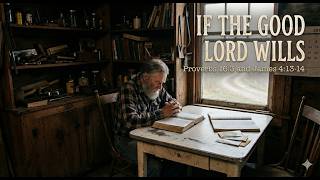
The Architecture of Providence: a Theological and Exegetical Analysis of the Interplay Between Proverbs 16:3 and James 4:13–17
Proverbs 16:3 • James 4:13-14
Summary: We face an inherent tension in the human condition: our capacity to plan for the future clashes with the undeniable fragility of our existence and the forces beyond our control, especially Divine Sovereignty. This paradox sparks existential anxiety and begs the question of our true agency. Two pivotal texts, Proverbs 16:3 and James 4:13–17, at first glance seem to offer contrasting views—one promising established plans through commitment, the other dismantling confidence with a stark reminder of our ephemeral nature. However, a rigorous analysis reveals they are not contradictory but rather complementary components of a unified theology of "Dependent Agency."
Proverbs 16:3 instructs us to "Commit your work to the Lord, and your plans will be established." The Hebrew verb *galal*, meaning "to roll," signifies a complete transfer of a heavy burden onto Yahweh, much like rolling a stone or a cylinder seal to claim ownership. It's about shifting responsibility for the outcome from our shoulders to God's. This act of faith—surrendering our deeds (*ma'aseh*)—is the prerequisite for the stability (*kun*) of our plans (*machashabah*). This isn't a promise of guaranteed material success, but a guarantee of *teleological success*: that our works and lives will be ordered and aligned with Divine Providence, preventing chaos and waste.
Conversely, James 4:13–17 confronts the arrogant presumption of those who confidently declare their future plans—"Today or tomorrow we will go to such and such a city, spend a year there, buy and sell, and make a profit"—without any acknowledgment of God. James exposes this as a manifesto of self-sovereignty, criticizing the absence of the subjunctive mood in their declarations. You are, in reality, a mere *atmis* (mist or vapor) that appears briefly and then vanishes, utterly unaware of what tomorrow truly holds. Such boasting is *alazoneia*, a form of evil arrogance where you claim powers you do not possess, essentially posing as God and usurping His prerogative.
The resolution to this tension, and the bridge between these two powerful messages, is found in James 4:15: "Instead you ought to say, 'If the Lord wills, we will live and do this or that.'" This doctrine of *Deo Volente* ("God willing") is not a superficial phrase, but a profound reorientation of your will, conditioning both your very existence and all your actions on God's sovereignty. Proverbs describes the *internal posture* of rolling your burdens onto God, an act of spiritual "If the Lord wills," while James provides the *external boundary* of confessing dependence, reminding you that even established plans are established *by Him*. Thus, we embrace Dependent Agency: diligently planning like the ant, but humbly trusting like the vapor. This posture replaces human arrogance with God-centered stewardship, resolving the anxiety of the unknown by placing our trust in the One who truly owns tomorrow.
1. Introduction: The Tension of Temporal Agency
The human condition is defined by a paradoxical relationship with time. Consciousness allows humanity to envision the future, construct elaborate scenarios of potentiality, and exert will to actualize those visions. Yet, this cognitive capacity for planning is housed within a finite, fragile existence that is utterly subject to forces beyond human control—biological decay, economic volatility, meteorological shifts, and the sovereign decrees of the Divine. The tension between the ability to plan and the inability to guarantee outcomes creates a profound existential anxiety. It raises the fundamental question of agency: To what extent does the human will shape reality, and where does the boundary of Divine Sovereignty begin?
In the canon of Judeo-Christian Scripture, two texts stand as monumental pillars addressing this specific tension: the Solomonic maxim of Proverbs 16:3 and the Jacobean admonition of James 4:13–17. On a cursory reading, they appear to offer divergent emotional landscapes. Proverbs 16:3 ("Commit your work to the Lord, and your plans will be established") seems to offer a formula for stability and success, a mechanism by which human anxiety is resolved through divine guarantee. Conversely, James 4:13–17 ("You do not know what tomorrow will bring... you are a mist") appears to dismantle human confidence, emphasizing the radical instability of existence and the arrogance of presumed continuity.
However, a rigorous exegetical and systematic analysis reveals that these texts are not contradictory poles but complementary components of a unified theology of "Dependent Agency." They do not negate human planning; rather, they situate it within its proper ontological context. This report provides an exhaustive examination of these passages, exploring their philological roots, historical Sitz im Leben (setting in life), and theological implications. By synthesizing the Wisdom literature of the Ancient Near East with the Apostolic instruction of the New Testament, we uncover a robust framework for navigating the future—one that rejects both the paralysis of fatalism and the idolatry of autonomy.
2. The Solomonic Foundation: Exegesis of Proverbs 16:3
To understand the interplay, one must first ground the analysis in the Hebrew wisdom tradition. Proverbs 16 is situated within a collection of Solomonic sayings that heavily emphasize the sovereignty of Yahweh over human affairs (cf. Prov 16:1, 16:9, 16:33). Verse 3 serves as a pivotal instruction on the mechanism of trust.
2.1 The Philology of "Commitment": The Metaphor of Galal
The English translation "commit" often fails to convey the visceral, physical nature of the Hebrew command. The verb used is gal (גֹּ֣ל), the imperative form of the root galal (גָּלַל). The primary lexical meaning of galal is "to roll" or "to roll away." It is a tactile term used in contexts of heavy physical exertion, such as Jacob rolling the stone from the mouth of the well (Genesis 29:3, 8) or Joshua commanding stones to be rolled against the mouth of a cave to seal it (Joshua 10:18).
In the theological context of Proverbs 16:3, the metaphor suggests the presence of a burden that is too heavy for the individual to carry or manipulate effectively. The "work" (ma'aseh)—the sum total of one's actions, business, and labor—is viewed as a weight. The command to "roll" this work onto Yahweh implies a decisive, complete transfer of the burden. It is not a request for assistance in carrying the load (synergism); it is a shifting of the center of gravity from the human shoulder to the Divine.
This imagery is echoed in Psalm 37:5 ("Commit your way to the Lord") and Psalm 22:8 ("He trusted on the Lord"). In both instances, the act of rolling denotes a radical abandonment of self-reliance. The distinct theological nuance here is that the "rolling" is an act of the will that precedes the emotional or intellectual resolution. One rolls the burden first; the establishment of thoughts follows. This challenges the modern sequence of planning, which often seeks intellectual certainty (plans established) before committing to action. Solomon reverses the order: surrender of the burden is the prerequisite for the stabilization of the mind.
2.2 Historical Context: The Cylinder Seal and Divine Ownership
A deeper layer of the galal metaphor may be excavated from the administrative practices of the Ancient Near East (ANE). In the Mesopotamian and Levantine context, ownership and authority were established through the use of cylinder seals. These were small, cylindrical stones engraved with intricate designs, often depicting deities or royal insignia. To authenticate a document, seal a storehouse, or mark a jar of grain as property, the owner would "roll" (galal) the seal across wet clay, leaving a raised impression.
This act of rolling the seal was a legal claim of ownership and protection. When the text commands the faithful to "roll" their works onto Yahweh, it arguably evokes this cultural concept of transferring ownership. To commit one’s work to God is to allow Him to stamp His seal upon it, thereby claiming it as His own property.
-
Implication of Ownership: If the work belongs to God, the responsibility for its outcome also resides with Him. The anxiety of the human agent is alleviated because they are no longer the "owner" of the project, but merely the steward.
-
Implication of Security: Just as a sealed storehouse was under the protection of the seal-owner (often the King), works rolled onto Yahweh are under His sovereign protection.
Table 1: The Spectrum of Galal (Rolling) in Scripture
| Biblical Reference | Context of Usage | Theological Implication | Source ID |
| Genesis 29:3 | Rolling a stone from a well | Physical exertion to access life-giving resources (water). | |
| Joshua 5:9 | Rolling away the reproach of Egypt | Removal of shame and the establishment of a new identity. | |
| Proverbs 16:3 | Rolling works onto Yahweh | Transfer of the burden of labor and outcome to Divine oversight. | |
| Psalm 22:8 | "He rolled himself on Yahweh" | Total existential reliance; used derisively by enemies to mock faith. | |
| Isaiah 34:4 | Heavens rolled up like a scroll | Eschatological finality and God’s power over the cosmos. | |
2.3 The Sequence of "Works" and "Plans"
The structural syntax of Proverbs 16:3 presents a causative sequence:
-
Protasis (Condition): Commit (gal) your works (ma'aseh) to the Lord.
-
Apodosis (Result): Your plans (machashabah) will be established (kun).
The Hebrew term ma'aseh refers to the actual deeds, the labor, or the products of one's hands. Machashabah refers to the thoughts, intentions, or devices—the cognitive strategies behind the actions. The promise is that the stability of the mind (plans) is the result of the surrender of the hand (works).
The verb kun ("established") means to be firm, stable, or prepared. It is used elsewhere to describe the establishing of a dynasty (2 Samuel 7:16) or the founding of the earth (Psalm 24:2). In the context of planning, it does not necessarily promise that the specific details of the human plan will be realized exactly as envisioned. Rather, it promises that the plans will find stability and alignment with reality.
-
Scenario A: If the plan aligns with God's will, He provides the resources to complete it (success).
-
Scenario B: If the plan opposes God's will, He blocks it (Proverbs 16:9). The "establishment" in this case is the correction of the sinner's path, bringing their life back into conformity with truth. A blocked plan that prevents ruin is a form of divine establishment.
Therefore, Proverbs 16:3 is not a "prosperity gospel" guarantee of material success for every business venture committed to prayer. It is a guarantee of teleological success—that the life and works of the committed individual will not be wasted or chaotic, but will be ordered (established) by Divine Providence.
3. The Jacobean Critique: Exegesis of James 4:13–17
While Proverbs provides the internal mechanism of trust, James 4 addresses the external expression of arrogance. Writing to the Diaspora (Jewish Christians scattered across the Roman Empire), James confronts a specific sociological group: the merchant class.
3.1 The Sociological Context: The Emporos in the Roman Economy
James 4:13 explicitly addresses "you who say, 'Today or tomorrow we will go to such and such a city, spend a year there, buy and sell, and make a profit'". This describes the emporos (merchant/wholesaler), distinct from the kapelos (local retailer).
-
The Roman Network: The 1st-century Roman Empire ("Pax Romana") facilitated an unprecedented explosion of trade. Roads were paved, sea routes were patrolled against piracy (to an extent), and a unified currency allowed for commerce from Britannia to Judea.
-
The Risk and Reward: Despite these advances, travel remained perilous. Shipwrecks, bandits, and sudden illness were common. A merchant planning a year-long circuit to a distant metropolis (like Antioch, Ephesus, or Alexandria) was undertaking a massive risk.
-
The Psychology of the Merchant: To survive and thrive in this environment required immense self-confidence. A successful merchant had to be decisive, calculating, and presumptuous. They had to believe they could navigate the variables of the market and the hazards of the road. James targets this specific psychology—the "self-made man" who believes his survival is due to his own competence rather than divine sustainment.
3.2 The Grammar of Presumption
James dissects the merchant's statement, revealing a manifesto of total control. The plan contains five distinct claims of sovereignty :
-
Time: "Today or tomorrow" (Sovereignty over chronology).
-
Location: "Such and such a city" (Sovereignty over geography).
-
Duration: "Spend a year there" (Sovereignty over survival).
-
Activity: "Buy and sell" (Sovereignty over vocation).
-
Outcome: "Make a profit" (Sovereignty over economics).
The interjection "Come now" (Age nyn) functions as a prophetic summons, demanding attention to the absurdity of these claims. James does not criticize the act of trading or making profit per se; he critiques the absence of the subjunctive. The merchants speak in the indicative mood ("We will"), asserting facts about the future that exist only as possibilities. This is "practical atheism"—living and planning as if God does not exist or is irrelevant to the machinery of commerce.
3.3 The Ontology of the Vapor (Atmis)
James counters the perceived solidity of the merchant's plan with the ontological reality of the merchant's existence: "For you are a mist (atmis) that appears for a little time and then vanishes" (James 4:14).
-
The Metaphor: Atmis refers to a vapor, steam, or smoke. It is the same word used in the Septuagint for the smoke of a sacrifice or the morning fog that clings to the hills of Judea before being burned off by the sun.
-
Epistemological Limit: Because the planner is a "mist," they possess a fundamental epistemological limit: "You do not know what tomorrow will bring" (James 4:14). The mist cannot comprehend the wind that blows it away. The merchant calculates profits (gain) but fails to calculate the probability of his own existence (life).
This imagery serves as a direct rebuke to the hubris of the plan. A year is a long time for a "vapor." To plan for a year without acknowledging the fragility of the self is not just optimism; it is delusion. This echoes the Wisdom tradition of Proverbs 27:1 ("Do not boast about tomorrow") but intensifies the reason: it is not just that events are uncertain, but that you are unstable.
3.4 The Diagnosis of Alazoneia (Arrogance)
James labels this presumptuous planning as "boasting in your arrogance" (James 4:16). The Greek word used is alazoneia (ἀλαζονεία). This is a rare and highly specific term, appearing only here and in 1 John 2:16 ("pride of life") in the New Testament.
-
Classical Usage: In classical Greek (e.g., Aristophanes, Plutarch), the alazon was a stock character in comedy—the "boastful impostor" or the "quack doctor". The alazon was a vagabond who wandered from town to town, claiming to possess skills, cures, or wealth that he did not actually have.
-
Theological Application: By applying this term to the wealthy merchants, James unmasks them. They view themselves as captains of industry; James views them as spiritual quacks. When a human claims "I will do X," they are claiming a power (omniscience/omnipotence) they do not possess. They are impostors, posing as gods.
-
Moral Verdict: James declares this boasting to be "evil" (ponera). It is not merely a social faux pas or a lapse in judgment; it is intrinsically wicked because it usurps the glory and prerogative of God. It is a rebellion against the creature-Creator distinction.
Table 2: Semantic Range of Alazoneia vs. Other Greek Terms for Pride
| Greek Term | Primary Meaning | Context in James | Source ID |
| Hyperephania | Haughtiness, looking down on others. | James 4:6 ("God opposes the proud") | |
| Alazoneia | Boastful pretension, quackery, claiming false power. | James 4:16 ("Boast in your arrogance") | |
| Kauchēsis | The act of glorying or rejoicing. | James 4:16 ("All such boasting is evil") | |
| Physiosis | Being "puffed up" or inflated. | Not used in James, but common in Paul. | |
Insight: The choice of alazoneia suggests that the sin of the merchants is not just that they are proud of what they have (wealth), but that they are proud of what they do not have (control over the future). It is the sin of delusional pretension.
4. The Theological Synthesis: Deo Volente as the Bridge
The resolution to the tension between the command to plan (Proverbs) and the warning against planning (James) is found in James 4:15: "Instead you ought to say, 'If the Lord wills, we will live and do this or that'".
4.1 The Doctrine of Deo Volente
The phrase "If the Lord wills" (often abbreviated D.V. for the Latin Deo Volente) serves as the theological bridge. It is not a magical incantation or a superstitious talisman to ward off bad luck. Rather, it represents a fundamental reorientation of the human will.
-
Conditioning Existence: James conditions two things on God's will: "We will live" AND "We will do this or that." This acknowledges God's sovereignty over both being (ontology) and doing (action).
-
The Liturgy of Dependence: John Calvin notes that while it is not necessary to verbally utter this phrase in every sentence (which would become pharisaical), the mindset it represents must saturate the believer's consciousness. It transforms planning from a prediction into a prayer. A plan effectively becomes: "Lord, I intend to go to Ephesus, subject to Your permission".
4.2 Harmonizing Proverbs and James
How does the "established plan" of Proverbs 16:3 coexist with the "uncertain vapor" of James 4:14? The harmony lies in the object of trust.
-
In Proverbs 16:3, the focus is on the Internal Mechanism: Rolling the burden onto God. The "establishment" promised is the alignment of the human will with the Divine will. When we "roll" the work, we are effectively saying "If the Lord wills" with our spirit. We release the demand for a specific outcome.
-
In James 4:15, the focus is on the External Expression: Confessing dependence. The "vapor" metaphor prevents the "established plan" from becoming an idol. Even though God promises to establish our steps, we must remember that those steps are established by Him, not by our intrinsic power.
Systematic Synthesis:
We plan like the Ant (Proverbs 6:6)—diligently, wisely, and with foresight.
But we trust like the Vapor (James 4:14)—humbly, contingently, and with open hands.
The fusion of these two creates the posture of "Dependent Agency." The Dependent Agent works hard (Proverbs) but carries no weight (Proverbs). They project into the future (James) but presume nothing (James).
4.3 The Sin of Omission (James 4:17)
James concludes this section with a haunting principle: "Therefore, to him who knows to do good and does not do it, to him it is sin" (James 4:17). In the context of the merchant, this defines the "sin of omission" regarding providence.
-
The "Good": The "good" is the humble acknowledgement of God's sovereignty (Deo Volente).
-
The Sin: If a merchant knows the theology of sovereignty (as a Jewish monotheist would) but continues to plan as a practical atheist, they are sinning. It is not enough to have correct orthodoxy; one must have correct orthopraxy in the marketplace. Ignoring God in business strategy is not just a lapse in judgment; it is a moral failure.
5. Comparative Wisdom and Intertextual Echoes
The interplay between these two texts is enriched by examining their resonance with other biblical and extra-biblical literature.
5.1 The Parable of the Rich Fool (Luke 12:16–21)
James 4:13–17 functions almost as a midrash (commentary) on Jesus' Parable of the Rich Fool. The structural parallels are undeniable.
Table 3: Intertextual Parallel – James 4 vs. Luke 12
| Element | The Rich Fool (Luke 12:16–21) | The Arrogant Merchant (James 4:13–17) |
| The Plan | "I will pull down my barns... I will say to my soul..." | "We will go... spend a year... make a profit." |
| The Presumption | Assumes he has "many years" laid up. | Assumes he has a "year" to trade. |
| The Divine Interruption | "This night your soul is required of you." | "You do not know what tomorrow will bring." |
| The Metaphor | Death/Judgment. | Vapor/Mist (Atmis). |
| The Verdict | Called "Fool" (Aphron). | Called "Arrogant" (Alazon). |
| The Error | Not "rich toward God." | Not saying "If the Lord wills." |
Both texts expose the futility of material accumulation in the face of ontological fragility. The "Fool" builds barns for grain he will never eat; the "Merchant" schedules trips he will never take. Proverbs 16:3 offers the preventative cure for this folly: by "rolling" the work onto God before the harvest, the planner acknowledges God's ownership of the barns and the soul alike.
5.2 Stoicism vs. Biblical Providence
The 1st-century Roman world was heavily influenced by Stoic philosophy. Stoics like Seneca and Epictetus also taught the uncertainty of the future and the need to accept fate (Amor Fati).
-
Stoic View: One should align with the Logos (impersonal reason) and accept whatever happens with detachment. The goal is Apatheia (freedom from passion/suffering).
-
Biblical View (James/Proverbs): One aligns with the Theos (personal God). The goal is not detachment, but Trust. The "rolling" of Proverbs 16:3 is an act of relational intimacy, not stoic resignation. The biblical planner does not just "accept" fate; they actively "commit" their work to a benevolent Father.
6. Systematic Implications: Sovereignty, Concurrence, and Work
6.1 The Doctrine of Concurrence
The interplay of Proverbs and James illustrates the doctrine of Concurrence (or Compatibilism)—the idea that God's sovereign will and human agency operate simultaneously.
-
Human Agency: We are commanded to "commit works" (Prov 16:3) and to say "we will live and do" (James 4:15). Humans are real causes; we really do plan, trade, and build.
-
Divine Sovereignty: God "establishes the steps" (Prov 16:9) and wills our continued existence.
God acts with and through human planning, not merely instead of it. The "rolling" of the burden is the mechanism by which the human will aligns itself with the Divine flow, preventing the friction of arrogance.
6.2 The Protestant Work Ethic and Reformation Thought
Martin Luther and John Calvin both engaged deeply with these texts.
-
Luther: Luther emphasized the dignity of vocation. He argued that God works through the masks (larvae) of human vocations. The merchant, the farmer, and the prince are all instruments of God's providence. Therefore, planning is a duty of love to the neighbor. However, Luther warned against the "unbelief" that trusts in the work rather than the God who empowers it.
-
Calvin: Calvin's commentary on James 4 emphasizes that the Deo Volente is the mark of a "godly mind." He argues that the arrogance of the merchants was a form of "stupidity"—forgetting they were men and not gods. For Calvin, true prudence involves planning diligently while recognizing that "men are not the lords of their own time".
7. Contemporary Application: The Ethics of Strategic Planning
In the modern context of corporate strategy, 5-year plans, and KPIs, the tension between Proverbs 16:3 and James 4 is acutely relevant.
7.1 Anxiety and the Burden of Outcomes
Modern professional life is plagued by anxiety, often driven by the pressure to control outcomes that are uncontrollable (market shifts, pandemics, consumer behavior). Proverbs 16:3 offers a psychological and spiritual release.
7.2 Ethical Planning: Avoiding the "Alazoneia" of the Pitch Deck
In startup culture and marketing, there is a temptation to "sell the vision" with absolute certainty ("We will disrupt the market," "We will capture 10% share").
-
Applying James 4: The Christian professional must navigate this by maintaining integrity. While one projects confidence in the plan, one maintains humility about the future. This might manifest in honest risk assessments, avoiding over-promising, and culturally appropriate ways of signaling contingency.
-
The Sin of Omission: For the Christian leader, failing to pray over the strategic plan or to acknowledge God's veto power in the boardroom is a violation of James 4:17. It is "practical atheism" in the workplace.
8. Conclusion: The Posture of Dependent Agency
The exhaustive analysis of Proverbs 16:3 and James 4:13–17 reveals a coherent, unified theology of the future. The texts do not stand in opposition; rather, Proverbs provides the internal posture (rolling the burden) while James provides the external boundary (acknowledging the vapor).
The synthesis calls the believer to a life of Dependent Agency:
-
Active: We are not fatalists. We plan, trade, go, and do (Proverbs 21:5).
-
Humble: We are vapors. We acknowledge our ignorance and fragility (James 4:14).
-
Surrendered: We roll the ownership of our plans onto God (Proverbs 16:3).
-
Conditional: We submit every ambition to the "If the Lord wills" clause (James 4:15).
In this posture, the arrogance of the self-made man is replaced by the confidence of the God-centered steward. The anxiety of the unknown tomorrow is resolved not by predicting it, but by trusting the One who owns it. This is the true "establishment" of plans—not that they always succeed in the market, but that they always succeed in the Kingdom.
Appendix: Detailed Historical and Linguistic Data
A.1 Linguistic Deep Dive: The Hebrew of Proverbs 16:3
| Hebrew Term | Root Meaning | Usage in Planning Context | Source |
| Galal (גָּלַל) | To roll, roll away, wallow. | Imperative command to transfer the weight of responsibility. Implies the burden is heavy. | |
| Ma'aseh (מַעֲשֶׂה) | Deed, work, business, product. | Refers to the execution phase. The physical labor and activity. | |
| Machashabah (מַחֲשָׁבָה) | Thought, device, plan, invention. | Refers to the cognitive/strategic phase. The design behind the work. | |
| Kun (כּוּן) | To be firm, stable, established, prepared. | The result of rolling. Stability of mind and purpose. Used of dynastic succession. | |