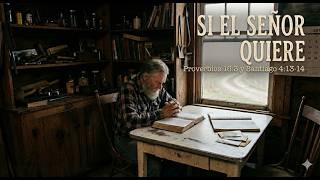
If the Lord Wills, We Will Live
Commit your works to the LORD and your plans will be achieved. — Proverbs 16:3
Come now, you who say, “Today or tomorrow we will go to this or that city, spend a year there, carry on business, and make a profit.” You do not even know what will happen tomorrow! What is your life? You are a mist that appears for a little while and then vanishes. — James 4:13-14

Author
Dr. Roberto Miranda
Summary: To acknowledge Jesus Christ as Lord is to accept his authority over every part of our lives and to seek his will before our own. James warns that planning trips, business ventures, or profits as though we controlled tomorrow expresses independence from God, even if it does not look like open rebellion. Our lives are brief and uncertain; that is why we say, “If the Lord wills, we will live,” and we will also do this or that. This surrender extends to our everyday decisions and to how we respond to illness, loss, and death. Rather than rebelling when something painful happens, we remain subject to his will and look to the Father in dependence, seeking his guidance and protection.
The posture of being wholly surrendered to the Will of God, of being like slaves before the Father’s purposes, has very practical implications. It helps us frame more precisely how we relate to God and how we interpret every event in our lives in light of God’s Lordship.
Here in James we have another of those passages that invite us to see the practical, lived implications of the posture the Lord seeks to instill in us through His parable of the servant who, in the end, after doing everything his master asks of him, must consider himself an unprofitable servant. And we have said that what the Lord wants to establish in us is the attitude of always seeking the Will of God, always looking to Him instead of looking to ourselves.
In James chapter 4, beginning with verse 13, we will see how understanding this truth of God’s supreme Lordship and the absolute submission of God’s children helps us better understand passages like James 4:13 and following. James says: “Come now, you who say, Today and tomorrow we will go to such-and-such a city, and we will stay there a year, and we will trade and make a profit, when you do not know what tomorrow will bring. For what is your life? It is certainly a mist that appears for a little while and then vanishes; instead, you ought to say: if the Lord wills, we will live, and we will do this or that.”
Do you see how, in a very interesting way, the apostle James is saying something very similar to what the parable of Jesus Christ implies? James implicates those Christians, or supposed Christians, who, even though they say they have surrendered themselves to God and His Will, actually live as though they were independent and think they can do whatever they please.
James asks: Hey, you people out there saying, Tomorrow I’m going to get up and go to such-and-such a city, and I’m going to buy this and sell that, and I’m going to do whatever I decide—even though you are not doing it from a posture of obvious, open rebellion, in the final analysis that is what you are doing. You are asserting your independence from God and rebelling against the Will of God instead of adopting the right attitude, one of total submission: the attitude a servant, a slave, should have toward his master, which is to say, If the Lord wills—that is, if Jesus Christ wills—we will live and do this or that.
Notice that, first, in the parable the Lord Jesus Christ calls us doulos, servants, slaves, and that other parable associated with Jesus Christ: kirios or kurios, which is the word translated into Spanish as señor, “lord.” The kurios is precisely the owner of the slaves; he is the master, the one who has complete authority over the slave, and that is the title given to Jesus Christ. When we call Jesus Christ “Lord,” we are saying to Him: You are completely sovereign over my life.
When we say, “Lord Jesus Christ,” we are saying to Him: We acknowledge, Lord, Your right to do whatever You want in our lives. So James says, “Instead of saying, If the Lord wills”—and notice how far that attitude of surrender must go—“if the Lord wills, we will live.” In other words, it is up to God whether I will be alive today or whether I will die. That is how far my surrender to God must go. God has the right. If today He wants to take my life and bring me into His Presence, that is His affair.
It is interesting that often, when we lose a loved one or something terrible happens—when a child falls ill or dies prematurely, or something we love very much is taken from us—we rebel against God. For how dare God take this from me prematurely, or how dare He send me an illness and take my life prematurely, as we see it? Yet our attitude should be: No, if God wants to do this in my life, I am subject to His Will.
Instead of an attitude of implicit independence, James invites us to one of absolute dependence on the Lord, to the point of saying to Him: Lord, what do You want me to do today? Where do You want me to go? What decisions do You want me to make in my work, in my life? Because, after all, You are the one who has the full right to do whatever You want in my life.
And the Bible is full of invitations like this one from the apostle James to see ourselves as wholly surrendered to the Will of God. We should always be looking to the Father as that weaned child looks to its mother for food and protection. That is the believer’s posture of greatness: total submission and surrender to the Will of God.
In our next meditation, we will turn to another aspect that, as I have said before, will actually invite us to see ourselves in a way almost opposite to this way of being slaves, but one that is entirely complementary. Those two attitudes must be the framework within which our lives unfold, and we will see how interesting this subject is from a theological point of view. God bless you, and until our next meditation.
What do you think?
What do you think about "If the Lord Wills, We Will Live"?
Related Content
If the Good Lord Wills
Navigating Tomorrow: the Believer's Call to Dependent Planning
Proverbs 16:3 • James 4:13-14
The human experience is marked by a deep tension: we possess the capacity to envision and plan for the future, yet our existence is fragile and utterl...
The Architecture of Providence: a Theological and Exegetical Analysis of the Interplay Between Proverbs 16:3 and James 4:13–17
Proverbs 16:3 • James 4:13-14
1. Introduction: The Tension of Temporal Agency The human condition is defined by a paradoxical relationship with time. Consciousness allows humanity...
Read in Context
Click to see verses in their full context.
Song (Other Languages)