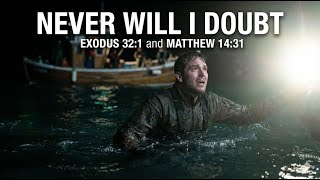
The Crisis of Absence and the Immediacy of Grace: an Exhaustive Intertextual and Theological Analysis of Exodus 32:1 and Matthew 14:31
Exodus 32:1 • Matthew 14:31
Summary: The relationship between the divine and human is inherently mediated through the tension of presence and absence. This fundamental tension inevitably tests human trust, particularly when sensory confirmation is withdrawn. Our analysis of Exodus 32:1, which recounts Israel's idolatry during Moses' perceived delay, and Matthew 14:31, depicting Peter’s doubt amidst a storm, reveals a singular theological axis: the struggle to maintain covenantal fidelity when the Mediator appears absent. These passages are typologically linked by themes of delayed mediation, a reliance on visual epistemology over faith, and the distinct responses of the Divine Mediator to human failure.
In both narratives, a vacuum of perceived authority precipitates crisis. The Hebrew term *boshesh*, describing Moses' delay, conveys not just lateness but shame and abandonment, prompting Israel to demand visible gods. Their faith, contingent on sight, collapsed when Moses disappeared, leading them to fabricate the Golden Calf—an ultimate artifact of visual epistemology. Similarly, Peter's failure on the Sea of Galilee stemmed from his shift in focus from Christ's word to the visible wind. His doubt, characterized by the Greek *distazo*, signifies a "double stance"—wavering between the visible threat and the invisible promise. Both instances underscore that idolatry and doubt often arise from elevating the visible above the audible Word of God.
A profound contrast emerges in the nature and response of the mediators. Moses, as the limited mediator, was absent on the mountain, unaware of Israel's sin, and descended with judgment, breaking the tablets of the Law and initiating a punitive response. His "hand" brought destruction. In contrast, Jesus, the divine Mediator, though initially on the mountain, was omniscient, actively "seeing" his disciples' struggle. He invaded their crisis by walking on water, extending his "hand" not for judgment but for immediate rescue. This signifies a trajectory from a covenant that condemns failure to one that sustains the struggling believer through grace.
This intertextual study offers crucial theological and ecclesiological implications for us today. The "delay" or perceived absence of the Mediator serves as a divine pedagogical tool, testing the endurance of faith by stripping away reliance on immediate gratification and visible support. Just as Israel succumbed to the "Calf" and Peter to the "wind," the Church in its "gap" between Christ's ascension and return is tempted to construct visible securities or succumb to the chaos of the cultural "waves." We are called to reject the *distazo* of a divided mind and, like Peter's desperate cry, to fix our eyes on Christ, the true "I AM," who, unlike the idols we fashion, meets us in our deepest chaos with rescue and peace. The "little faith" that cries out to Jesus is infinitely superior to the zeal that manufactures its own gods.
1. Prolegomena: The Hermeneutics of Absence and the Visuality of Faith
The relationship between the divine and the human is inevitably mediated through the tension of presence and absence. Throughout the biblical narrative, this tension precipitates a recurring crisis of faith, revealing the fragile nature of human trust when stripped of sensory confirmation. The human creature, bound by time and space, fundamentally craves a deity who is tangible, visible, and strictly strictly adherent to human timetables. When the divine mediator—whether the prophet Moses on Sinai or the Incarnate Son on the Sea of Galilee—withdraws from immediate perception, the "gap" or "delay" creates a vacuum. It is within this vacuum that the human heart is tested, and it is within this vacuum that the twin failures of idolatry and doubt emerge as the primary coping mechanisms of the finite mind grappling with the Infinite.
This report provides an exhaustive, expert-level analysis of the interplay between two seminal texts: Exodus 32:1, which narrates the Israelites' corporate lapse into idolatry during the perceived delay of Moses, and Matthew 14:31, which depicts the Apostle Peter’s individual crisis of doubt amidst the storm on the Sea of Galilee. While separated by over a millennium, distinct covenants, and radically different literary genres, these two passages converge on a singular theological axis: the struggle to maintain covenantal fidelity when the Mediator appears absent.
The analysis will demonstrate that the Golden Calf incident and Peter’s sinking are not merely disparate historical events but are typologically linked through the themes ofdelayed mediation,visual epistemology(the reliance on sight over faith), and the differing responses of theDivine Mediatorto human failure. By juxtaposing the "delayed" Moses who brings judgment with the "immediate" Jesus who brings rescue, we uncover a profound theological trajectory from the fragility of the Law to the sustaining power of Grace. The investigation will proceed through a rigorous philological examination of key terms—specifically the Hebrewboshesh(delay/shame) and the Greekdistazo(doubt/double-standing)—and will synthesize these findings into a comprehensive theology of faith in the "fourth watch" of human experience.
1.1 The Thematic Bridge: Faith in the Vacuum
The core conflict in both narratives arises from a vacuum of perceived authority. In Exodus 32:1, the vacuum is temporal and spatial: Moses is physically absent on the mountain, and time has stretched beyond the people's capacity to wait.The cloud that covers the mountain, once a symbol of God's glory, has become a symbol of His silence. In Matthew 14:22-33, the vacuum is environmental and existential: the disciples are isolated in a boat, battered by a storm, with Jesus initially absent until the "fourth watch" of the night.
In both instances, the crisis is precipitated by the intersection of a hostile environment (the wilderness/the storm) and a delayed savior. The interplay between these texts exposes the anatomy of doubt: it is not merely an intellectual rejection of God but a "double-standing" (distazo) or wavering between two realities—the visible threat and the invisible promise.As we shall see, the Golden Calf is the corporate, cultic expression of the same internal instability that Peter experienced individually on the waves.
2. Exegetical Analysis of Exodus 32:1: The Theology of Delay and the idolatry of Sight
To grasp the full weight of the interplay between these texts, one must first descend into the camp of Israel at the foot of Sinai. The incident of the Golden Calf is not a random act of rebellion; it is a calculated theological maneuver born of panic.
2.1 The Context of the Covenant: The "Forty Days" as Probation
The narrative of Exodus 32 cannot be severed from the preceding chapters. The Israelites had just entered into a solemn covenant, ratified by blood, declaring, "All that the Lord has spoken we will do" (Exodus 24:3).They had witnessed the terrifying theophany of Yahweh—thunder, lightning, and the thick cloud. Moses had ascended into this cloud to receive the tablets of the testimony, a period defined as "forty days and forty nights" (Exodus 24:18).
In biblical numerology, the number forty is inextricably linked to testing, probation, and the maturation of faith. It anticipates the forty years of wilderness wandering, the forty days of Elijah’s journey, and, crucially for our comparison, the forty days of Jesus’ temptation and the period between his resurrection and ascension.For the Israelites, recently liberated from the visual-heavy culture of Egypt, this period was a specific test of their ability to worship an invisible God without a visible mediator. The failure of this test is the subject of verse 1: "Now when the people saw that Moses delayed to come down from the mountain...".
The text implies that the duration of the delay was the primary catalyst for the sin. It was not the hardship of the wilderness or the threat of an enemy that broke them; it was the silence of God's representative. The delay created a space where the memory of the Red Sea began to fade, and the immediate reality of their leaderlessness began to dominate their consciousness.
2.2 Philological Deep Dive: The Hebrew Conception of Delay (Bosh)
The Hebrew verb used for "delayed" in Exodus 32:1 isboshesh(from the rootbush). This linguistic choice is profound and multifaceted. While in this context it denotes a delay in time, its root meaning is connected to shame, disappointment, or confusion.Thehiphilorpolelstem suggests causing shame or acting in a shameful manner through delay.
The Nuance of Shame:The people were not merely noting a scheduling conflict; they were experiencing a sense of shame. To be left leaderless in the Ancient Near East was a shameful condition, implying that their deity had abandoned them or that their leader had failed. The delayshamedtheir confidence.
The Subjectivity of Time:Rabbinic commentary, particularly that of Rashi, offers a fascinating insight into the psychology of this delay. Rashi suggests the people made a calculation error. Moses had promised to return at the end of forty days. The people included the day of his ascent in their count, expecting him on the 16th of Tammuz. When noon arrived and he did not appear, "Satan came and threw the world into confusion," showing them a vision of Moses' bier suspended in the sky.
This Midrashic tradition, while extra-biblical, captures the psychological truth of the text: The delay was interpreted as death. "As for this Moses, the man who brought us up... we do not know what has become of him" (Exodus 32:1).The use of the demonstrative "this Moses" (zeh Mosheh) is dismissive, bordering on contempt. It reveals that their attachment was to themanMoses, the visible hero, rather than to the God who sent him. The delay revealed the idolatry that was already present in their hearts: they were followers of Moses, not yet worshippers of Yahweh.
Crucially, Moses was not actually "late" according to God's timetable; he was exactly where he needed to be, receiving the blueprint for the Tabernacle—the very structure intended to solve the problem of God's presence.The delay was entirely subjective, born of the people's impatience and their inability to submit to a divine timeline that contradicted their own. This creates a theological paradigm:"Delay" is often a divine instrument for testing the maturity of faith, forcing the believer to rely on the promise rather than the immediate presence.
2.3 The Demand for Visibility: "Make Us Gods"
The people’s demand to Aaron—"Up, make us gods (elohim) who shall go before us"—is a direct reversion to Egyptian religious epistemology, where the divine was always represented in form.The text notes that they "gathered themselves together unto Aaron," a phrase that implies a menacing, mob-like assembly.
The pluralelohimcan be translated as "gods" or "a god." Given that they later identify the single calf as the deity who brought them out of Egypt ("This is your god, O Israel," Exodus 32:4), it is likely they were seeking a newmediatoror a tangible representation of Yahweh, rather than a totally new pantheon.This is an act ofsyncretism—worshipping the true God through forbidden modes—rather than pure paganism. However, the text treats it as apostasy because it violates the Second Commandment (prohibiting images) immediately after receiving it.
The choice of a calf (or young bull) is significant. In the Ancient Near East, the bull was a ubiquitous symbol of strength, virility, and divinity.
Apis Bull:In Egypt, the Apis bull was considered a living manifestation of the creator god Ptah. The Israelites, having lived in Goshen, would have been intimately familiar with this cult.
Canaanite Baal:The bull was also the symbol of El and Baal in Canaanite religion, representing power and fertility.By reducing the transcendent Yahweh to a bovine image, they attempted to domesticate the divine, making God manageable, visible, and present on their terms. They wanted a god who could "go before them"—a visible vanguard to replace the pillar of cloud that perhaps felt too abstract or stationary during Moses' absence.
2.4 The Failure of Aaronic Leadership and the "Feast to the Lord"
Aaron’s capitulation stands in stark contrast to Moses’ intercession. Confronted with the mob’s anxiety, Aaron does not point them back to the invisible God or the covenant promises. Instead, he facilitates their sin by demanding their gold—material wealth given to them by God during the Exodus—and fashioning it into an idol.
Aaron's attempt to sanitize the idolatry by proclaiming "Tomorrow shall be a feast to the Lord" (Exodus 32:5) illustrates the danger of religious compromise.He attempts to merge the worship of Yahweh with the visual methodology of the nations, a syncretism that God rejects as "corrupting" the people. The subsequent celebration—"they rose up to play"—uses a Hebrew verb (tzaḥaq) that implies sexual revelry and chaotic indulgence, confirming that when the form of worship is corrupted, the morality of the worshippers inevitably follows.
This section of the analysis establishes the "Exodus baseline":When the mediator delays, the human heart manufactures a visible substitute to alleviate the anxiety of absence.
3. Exegetical Analysis of Matthew 14:31: The Anatomy of Doubt and the Physics of Faith
We now turn to the New Testament counterpoint. The narrative of Jesus walking on the water (Matthew 14:22-33) occurs immediately after the Feeding of the Five Thousand. The structural parallels to Exodus are deliberate and profound. Like Moses, Jesus dismisses the crowds and ascends a mountain to pray alone (Matthew 14:23).This spatial arrangement mirrors the Sinai event: the Mediator is on the mountain with God, while the disciples (the new Israel) are below, struggling in the "wilderness" of the sea.
3.1 The Context of the Storm: The "Fourth Watch"
The disciples are in the boat, "beaten by the waves, for the wind was against them" (Matthew 14:24). The timing is critical: the "fourth watch of the night" (between 3:00 AM and 6:00 AM).This detail is not merely chronological; it is theological.
The Duration of Struggle:The disciples had been rowing against the wind for hours, perhaps since the previous evening. They were exhausted, battered, and enveloped in darkness. This extended period of struggle serves as the New Testament counterpart to the "forty days" of delay in Exodus. It represents the limit of human endurance, the point where hope begins to fade.
The Divine Timing:Jesus waited until the fourth watch—the darkest hour before dawn—to come to them. This delay was intentional. Just as Moses' forty-day absence tested Israel, Jesus' delay tested the disciples. It forced them to confront the reality that they could not save themselves, dismantling their self-reliance as experienced fishermen.
3.2 The Physics of Faith: "Bid Me Come"
When Jesus approaches on the water, the disciples initially react with fear, thinking he is a ghost (phantasma).This reaction underscores their spiritual blindness; they, like the Israelites, could not recognize the divine presence in an unexpected form. Jesus identifies himself with the divine formulaEgo eimi("I AM"), echoing the divine name revealed to Moses (Exodus 3:14) and asserting his sovereignty over the chaos of the sea, a prerogative belonging to Yahweh alone (Job 9:8).
Peter’s response—"Lord, if it is you, command me to come to you on the water" (Matthew 14:28)—is a bold request for participation in the divine power. Unlike the Israelites who wanted a god broughtdownto their level (the calf), Peter asks to be raisedupto the level of the divine (walking on water).He steps out of the boat, the vessel of safety, and walks on the chaos of the sea, sustained entirely by the command of Jesus. This moment represents the pinnacle of "starting faith"—the willingness to leave the secure structure for the dynamic presence of Christ.
3.3 The Mechanism of Failure: Philological Analysis ofDistazoandOligopistos
The pivotal moment occurs in verse 30: "But when he saw the wind, he was afraid, and beginning to sink he cried out, 'Lord, save me!'" Peter's failure is epistemological. As long as his focus was on the person of Jesus, the laws of physics were suspended. When his focus shifted to the "wind" (the visible threat), gravity reasserted itself.
Jesus’ rebuke in verse 31 is linguistically precise and serves as the hermeneutical key to the entire passage: "O you of little faith (oligopistos), why did you doubt (edistasas)?"
3.3.1Oligopistos: Quality or Quantity?
The termoligopistosis a compound adjective (oligos = little + pistis = faith). It appears five times in the New Testament, always in Matthew or Luke, and always addressed to the disciples.
Not "Unbelief":It does not mean "no faith" (apistia). Peter had enough faith to get out of the boat, which is more than the other eleven disciples had.
Duration vs. Size:As noted in the research,oligopistoslikely refers to thedurationorconstancyof faith rather than its initial size. Peter’s faith was "little" because it was brief. It started strong but could not sustain itself against the visible evidence of the storm. It was a "flash" faith, not a "staying" faith. This parallels the Israelites, who sang praises at the Red Sea (Exodus 15) but fell into idolatry mere weeks later. Their faith, too, wasoligopistos—intense but ephemeral.
3.3.2Distazo: The Theology of the Double Stance
The verbdistazois exceedingly rare, appearing only here and in Matthew 28:17 ("some doubted").Its etymology provides a stunning visual image of Peter's internal state.
Etymology:It is derived fromdis(twice) andstasis(standing/stance). It literally means to "stand twice" or to assume a "double stance".
The Divided Mind:The word describes a person who is divided, wavering between two options or realities. Peter was physically standing on the water (sustained by the Word), but mentally he began to stand on the logic of the storm (sustained by physics). He tried to inhabit two worlds simultaneously: the supernatural world of Jesus and the natural world of the wind.
Connection to James:This concept anticipates James 1:8, which speaks of the "double-minded man" (dipsychos) who is "unstable in all his ways."Distazois the physical manifestation of double-mindedness.
This definition of doubt—as a divided mind or double stance—connects directly to the Israelites' condition in Exodus 32. They, too, were "standing twice": attempting to hold onto Yahweh ("Feast to the Lord") while standing on the visible security of the Calf. They wanted the covenant of Sinaiandthe visual comfort of Egypt. Both texts reveal thatdoubt is not the absence of belief, but the attempt to serve two masters—the invisible God and the visible crisis.
4. Intertextual Synthesis: The Interplay of Exodus 32:1 and Matthew 14:31
Having established the exegetical foundations of both texts, we now proceed to the core of the analysis: the interplay. The juxtaposition of these narratives reveals deep structural, typological, and theological parallels that illuminate the nature of faith, the problem of divine timing, and the character of the mediator.
4.1 The Theology of Time:Boshvs. The Fourth Watch
Both narratives are predicated on a crisis of timing. In Exodus 32, the crisis is the "delay" (bosh) of Moses. In Matthew 14, it is the lateness of the hour (the fourth watch) and the extended struggle of the disciples against the wind.
Feature
Exodus 32 (Israel)
Matthew 14 (Peter)
Temporal Context
"Forty Days" of waiting
"Fourth Watch" of the night
Psychological State
Impatience, Shame (Boshesh)
Exhaustion, Fear (Phobos)
Interpretation of Delay
Abandonment ("We know not what has become of him")
Isolation (Jesus is absent)
Response to Delay
Fabrication: Making a visible god
Desperation: Crying out to the Lord
Insight:The "testing of patience" is a divine pedagogical tool. The forty days of Moses and the long night of the disciples serve the same function: they strip away the believer’s reliance on immediate gratification and visible support. Faith is revealed not in the moment of initial enthusiasm (the ratification of the covenant or the stepping out of the boat) but in the endurance of the delay.The interplay suggests thatidolatry is often a reaction to God's timing, a refusal to endure the "fourth watch" where He typically arrives.
4.2 Visual Epistemology: Sight as the Enemy of Faith
The most striking parallel between the two texts is the role of sight. The vocabulary of "seeing" is pivotal in both narratives.
Exodus 32:1: "Now when the peoplesaw(yar) that Moses delayed..." Their faith was contingent on sight. When the visible mediator (Moses) disappeared, their faith collapsed. They demanded a god they could see ("go before us") because they could not trust a God they could not see. The Calf was the ultimate artifact of visual epistemology—a god that could be touched, seen, and carried.
Matthew 14:30: "But when hesaw(blepon) the wind..." Peter’s walking on water was an act of non-visual faith (trusting the auditory command "Come"). His sinking was an act of visual fear. The text explicitly links his visual perception of the wind (the effects of the wind on the water) to his fear.
Synthesis:In both narratives, "seeing" is the antithesis of "believing." To see the delay is to doubt the return; to see the wind is to doubt the power of Christ. The interplay suggests a theological axiom:Idolatry and doubt are both consequences of elevating the visible above the audible (the Word of God).The Golden Calf is the materialization of the need to see; Peter's sinking is the physicalization of the failure to ignore what is seen in favor of what is heard.
4.3 The "Little Faith" of Israel and Peter
Jesus' rebuke of Peter asoligopistosallows us to retroactively diagnose the spiritual condition of Israel. The Israelites are often described in the Old Testament as "stiff-necked" and faithless (Deut 32:20 calling them "children in whom is no faith").
Flash Faith:Israel believed at the Red Sea (Exodus 14:31). Peter believed when he stepped out of the boat. Both experienced miracles.
The Collapse:The collapse came when the environment (wilderness/storm) contradicted the promise.
The Trajectory:The interplay reveals that "little faith" is not the absence of faith but theinterruptionof faith by fear. However, the trajectory differs: Israel's "little faith" turnedawayfrom God to an idol; Peter's "little faith" turnedtowardGod in a cry for help. This is the crucial difference between apostasy and struggling faith. Peter sunk, but he sunktowardsJesus. Israel sunkawayfrom Yahweh.
5. The Mediatorial Contrast: Moses vs. Jesus
The interplay between Exodus 32 and Matthew 14 reaches its theological zenith in the comparison of the mediators. Moses and Jesus are typologically linked throughout Matthew's Gospel (Jesus as the New Moses), yet their actions in the crisis differ in ways that highlight the superiority of the New Covenant.
5.1 The Absent vs. The Present Mediator
Moses (The Limited Mediator):In Exodus 32, Moses is characterized by hisabsence. He is on the mountain, disengaged from the people's immediate struggle. He is unaware of the idolatry until God informs him (Exodus 32:7).His absence creates the vacuum that the Calf fills. He is a man, limited by space and time.
Jesus (The Divine Mediator):In Matthew 14, Jesus is initially physically absent (on the mountain), but he possesses divine omniscience. Mark's parallel account notes that "he saw them straining at the oars" (Mark 6:48) even from the land.Jesus bridges the distance by walking on the water. He does not leave them in the vacuum; he invades their crisis. He demonstrates that he is never truly "absent," even when invisible.
5.2 The Typology of the "Hand": Judgment vs. Rescue
A potent visual parallel exists between the use of the "hand" in both narratives, serving as a metonym for the nature of the covenant each mediator represents.
The Hand of Moses (Exodus):
Moses comes down with the tablets of the Law in hishand(Ex 32:15).
Upon seeing the Calf, his anger burns, and he throws the tablets from hishands, shattering them (Ex 32:19). This signifies the breaking of the covenant.
He commands the Levites to "consecrate yourhandsto the Lord" (Ex 32:29) by drawing swords and killing their brothers, sons, and neighbors.
Theological Implication:The hand of the Law brings revelation, but when met with sin, it brings judgment, breakage, and death.
The Hand of Jesus (Matthew):
When Peter cries out, "Immediately Jesus stretched out hishandand took hold of him" (Matt 14:31).
Jesus does not use his hand to strike Peter for his doubt; he uses it to save him.
Theological Implication:The hand of Grace grasps the sinking sinner. This typological shift signifies the movement from a covenant that breaks the sinner (Exodus) to a covenant that holds the sinner (Matthew).The "outstretched hand" of God, often a symbol of judgment in the OT (Exodus 3:20), becomes the instrument of salvation in the NT.
5.3 The Response to Failure: Consumption vs. Communion
Moses' Solution:Moses destroys the idol, grinds it to powder, scatters it on the water, and forces the Israelites to drink it (Exodus 32:20).This is a ritual of ordeal (similar to the Sotah ritual in Numbers 5), forcing the people to internalize their sin. It is a bitter communion of judgment.
Jesus' Solution:Jesus catches Peter, and together they get into the boat. The wind ceases (Matthew 14:32). The result is not a massacre but worship: "Those in the boat worshiped him, saying, 'Truly you are the Son of God'" (Matthew 14:33). The crisis of doubt ends in a communion of presence and peace.
6. The Psychological Dimensions of Idolatry and Doubt
The research material supports a psychological reading of these texts, suggesting that idolatry and doubt are cognitive responses to high-stress environments.
6.1 The Psychology of the Golden Calf: Anxiety and Substitution
The Golden Calf was a collective coping mechanism for anxiety. The research suggests that the Israelites, fresh from slavery, suffered from "collective panic" upon the disappearance of their leader.
Leadership Vacuum:In the ancient mind, the leader was the link to the divine. Without Moses, the cosmic order seemed to dissolve.
Transitional Object:Psychologically, the Calf served as a "transitional object"—a tangible item to manage the fear of the unknown wilderness. It provided a false sense of control. The "play" (orgies/revelry) associated with the Calf was a release of this tension, a regression to the primal senses.
Cognitive Distortion:They convinced themselves that the Calfwasthe god who brought them out of Egypt (Ex 32:4). This is a delusion born of desperation—a rewriting of history to fit their current need for a visible deity.
6.2 The Psychology of Sinking: Cognitive Dissonance
Peter’s sinking was a result of "cognitive dissonance".
Selective Attention:The human brain is wired to prioritize immediate physical threats. As the research notes (citing the "Invisible Gorilla" paradigm), humans focus on the most salient stimulus. The "wind" (sensory data) overwhelmed the "word" (faith data).
Regression:Doubt, in this sense, is a psychological regression to the "default mode" of survival. Just as the Israelites regressed to Egyptian religion, Peter regressed to the natural laws of physics. He "saw the wind" and forgot the Christ.
7. Theological Synthesis: The "I AM" and the Anti-Idol
A profound theological antithesis emerges regarding the identity of God.
The False "I AM":In Exodus 32:4, the people point to the Calf and say, "This is your god (Elohim)." They attempt to assign the attributes of the Savior (who brought them out of Egypt) to a created object. This is the ultimate lie: identifying the Creator with the creature.
The True "I AM":In Matthew 14:27, Jesus speaks into the darkness: "Take heart; it is I (Ego eimi)." This phrase, "I AM," is the covenant name of Yahweh. Jesus asserts his divinity not through a static image (like the Calf) but through dynamic dominion over chaos (walking on the sea).
The Intertextual Lesson:The interplay teaches thatthe true God is not found in the static images we create to comfort ourselves (idols) but in the living Person who meets us in the chaos.The "Wind" in Matthew 14 functions similarly to the "Calf" in Exodus 32: both are rivals to God. To fear the wind is to idolize it (giving it power over one's life); to worship the Calf is to idolize it. Jesus conquers both: he exposes the Calf as a lie (by being the true presence) and he calms the Wind (showing his supremacy over nature).
8. Ecclesiological Implications: The Church in the "Gap"
The analysis concludes by applying this intertextual study to the current state of the Church.
The Age of the "Delay":The Church currently exists in the "gap" between the Ascension (Jesus going up the mountain) and the Parousia (His return). Like the Israelites, we are waiting for the Mediator to return from the mountain.
The Temptation of the Calf:In this delay, the temptation is to build "Golden Calves"—visible institutions, political powers, or sensory experiences—to mediate the presence of the absent Christ. We want a "god to go before us" that we can see and control.
The Call to the Fourth Watch:The lesson of Matthew 14 is that in this "gap," the church must not look at the "waves" (cultural chaos) or build "calves" (idols of security), but must fix its eyes on the promise of His coming. We must learn to endure the "fourth watch" without succumbing to the panic that leads to idolatry.
The Posture of Faith:The antidote to the Golden Calf is not mere willpower; it is the cry of Peter: "Lord, save me!" It is the acknowledgment that we cannot survive the delay on our own resources. We need the outstretched hand of the Mediator.
9. Conclusion
The interplay between Exodus 32:1 and Matthew 14:31 offers a comprehensive theology of human frailty and divine faithfulness. Both texts expose the inherent weakness of human faith when confronted with delay, absence, and danger.
The Fragility of Sight-Based Faith:The Israelites failed because they needed to see a god; Peter failed because he saw the storm. Both confirm that "faith is the assurance of things not seen" (Hebrews 11:1).
The Superiority of Christ:While Moses stands as a monumental figure of intercession, his "delay" precipitated judgment. Jesus, the "prophet like Moses," does not merely bring the law down from the mountain; he comes down from the mountain to lift the believer up from the depths.
The Final Word:The transition from Exodus 32 to Matthew 14 is the transition from self-manufactured security (idolatry) to desperate dependence on the Savior (faith). The "little faith" that cries out to Jesus is infinitely superior to the "great" religious zeal that builds a golden calf.
In the final analysis, the believer is called to reject the "double stance" (distazo) of trying to serve both the visible world and the invisible God. We are called to stand on the water, sustained only by the word of the One who says, "It is I; do not be afraid."
Summary Comparison Table
Feature
Exodus 32:1 (The Golden Calf)
Matthew 14:31 (Peter Sinking)
Crisis Catalyst
Delay(boshesh) of the Mediator
Distance/Storm&Fourth Watch
Human Reaction
"Make us gods we can see." (Idolatry)
"Lord, save me!" (Desperation)
Root Failure
Sight: "We do not know what has become of him."
Sight: "When he saw the wind..."
Philology of Doubt
Seeking a substitute mediator
Distazo(Standing twice/Wavering)
Mediator's Status
Absent on the mountain (unaware)
Present on the water (omniscient)
Symbol of Covenant
Handbreaking the Law / Killing
Handcatching the sinner
Outcome
Judgment (Sword/Plague)
Rescue (Peace/Worship)
Theological Key
The Law condemns the faithless.
Grace rescues the "little faith."
💬
What do you think?
What do you think about "The Crisis of Absence and the Immediacy of Grace: An Exhaustive Intertextual and Theological Analysis of Exodus 32:1 and Matthew 14:31"?