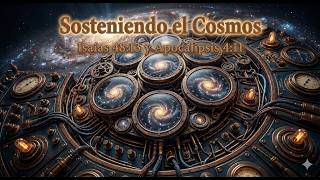
The Cosmic Courtroom and the Heavenly Throne: an Exhaustive Intertextual Analysis of Isaiah 48:13 and Revelation 4:11
Isaiah 48:13 • Revelation 4:11
Summary: The doctrine of creation is not merely an introductory note within biblical theology, but the essential foundation upon which all understanding of divine sovereignty, redemptive acts, and mandated worship is constructed. The biblical narrative anchors history and eschatological hope in the mechanics of divine creation, requiring us to understand God's relationship to the cosmos He brought forth. Two pivotal passages, Isaiah 48:13 and Revelation 4:11, though separated by centuries and distinct literary genres, engage in a profound dialogue that collectively establishes a paradigm where cosmology directly dictates our theology and worship. These texts vehemently reject any idea of a passive deity or a universe born from unguided chaos, insisting instead upon a cosmos created *ex nihilo*, calibrated by infinite wisdom, and sustained by an omnipotent command.
In Isaiah 48:13, we find a fierce prophetic courtroom oracle addressed to an exiled Israel, challenging their idolatry and perceived divine impotence against the backdrop of Babylonian imperial power. Yahweh asserts His exclusive authority by anchoring audacious historical predictions in His undisputed cosmological mastery. The text emphasizes direct, unmediated divine agency, declaring that "My own hand founded the earth, and My right hand spread out the heavens." Crucially, the Hebrew verb tenses reveal that while God's initial acts of founding and spreading were completed historical actions, His subsequent "summoning" of the heavens and earth to "stand up together" denotes an ongoing, habitual, and continuous act of sustenance. The universe does not merely endure passively; it perpetually obeys its active Creator.
Centuries later, Revelation 4:11 shifts our focus to a transcendent, apocalyptic vision granted to the exiled Apostle John. Here, in the ultimate heavenly throne room, the sovereign Creator receives unceasing, ecstatic worship from a celestial court. This vision provided radical reassurance to persecuted believers under the oppressive Roman imperial cult, demonstrating that despite Rome's terrifying power, a higher, occupied throne actively rules over all of history. The elders cast their crowns, declaring "Worthy are you, our Lord and God, to receive glory and honor and power, for you created all things, and by your will they existed and were created." This affirmation highlights *thelēma*, God's uncaused, free will, as the sole catalyst for all reality. Just as in Isaiah, the Greek perfect tense speaks to a singular act of creation, while the imperfect tense for "existed" powerfully communicates the continuous, active preservation and sustenance of the cosmos by God's perpetual will.
Thus, when we place Isaiah 48:13 and Revelation 4:11 in intertextual dialogue, they forge a unified biblical cosmology. They assert that God is not merely the initiator of the universe, but its active, intimate sustainer, dismantling any deistic worldview. This comprehensive truth — that the universe is not a cosmic accident but a finely tuned, mathematically precise masterpiece sustained by its Maker's continuous, spoken decree — carries immense implications for our lives. It grounds objective moral law, provides profound comfort and assurance amidst chaos, and stands in uncompromising opposition to religious pluralism. The ultimate purpose of this creation is doxology, the joyful glorification of its Creator. Our only logical, rational, and theologically fitting response is to cast down all earthly crowns and return all glory, honor, and power to the One whose creative supremacy demands nothing less.
Prolegomena: The Theological Locus of Cosmic Origins
Within the architectural framework of biblical theology, the doctrine of creation does not merely function as an explanatory prologue to human history; rather, it constitutes the foundational bedrock upon which all subsequent declarations of divine sovereignty, prophetic authority, redemptive intervention, and doxological mandate are constructed. The biblical narrative operates on a continuum that anchors redemptive history and eschatological hope explicitly upon the mechanics and implications of divine creation. To understand the nature of the Biblical God is to first understand His relationship to the cosmos He spoke into existence. Among the vast expanse of the scriptural canon, two specific passages emerge as pivotal, intertextual nodes articulating the supremacy, absolute authority, and sustained engagement of the Creator: Isaiah 48:13 and Revelation 4:11.
Though separated by several centuries, composed in entirely different geopolitical contexts, and utilizing distinct literary genres—one a prophetic courtroom oracle, the other an apocalyptic vision—these texts engage in a profound and complementary theological dialogue. They collectively establish a paradigm wherein cosmology directly dictates theology, theodicy, and worship. Isaiah 48:13 operates within a fierce prophetic courtroom discourse, addressing an exiled and hypocritical Israel, utilizing the vivid imagery of Yahweh as the master architect who lays the bedrock foundations of the earth and commands the starry host as a mustered army. Revelation 4:11, conversely, is situated within a transcendent apocalyptic vision granted to an exiled apostle on Patmos, presenting the ultimate heavenly throne room where the sovereign Creator receives unceasing, ecstatic worship from the celestial court precisely because His uncaused will is the sole catalyst for all material and spiritual existence.
The interplay between these two canonical texts reveals a beautifully unified biblical witness regarding the precise nature of God's sovereignty. Both texts vehemently reject the notion of a passive, deistic entity or a universe born of chaotic, unguided struggle. Instead, they insist upon a cosmos brought forth creatio ex nihilo (out of nothing), finely calibrated by infinite divine wisdom, and continually sustained moment by moment by an omnipotent command. This exhaustive report will rigorously examine the historical contexts, exegetical nuances, philological depths, and expansive theological intersections of Isaiah 48:13 and Revelation 4:11. By synthesizing classic commentaries, linguistic analysis, ancient Near Eastern polemics, and modern cosmological observations, this analysis will demonstrate how the biblical theology of creation functions simultaneously as the ultimate polemic against idolatrous empires and the supreme catalyst for authentic human and angelic worship.
The Historical and Covenantal Matrix of Isaiah 48
The Exilic Crisis and the Courtroom Motif
To comprehend the profound theological weight of Isaiah 48:13, one must first immerse oneself in its specific historical and literary horizon. Isaiah chapters 40 through 55 are frequently designated by scholars as the "Book of Comfort," a section that speaks prophetically into the trauma of the Babylonian exile. However, within this broad thematic section of comfort lies a fierce, uncompromising polemic against idolatry and covenantal unfaithfulness. Chapter 48 functions specifically as Yahweh's concluding courtroom address—a cosmic lawsuit or rîb—directed toward a rebellious and profoundly hypocritical Israel.
The text explicitly identifies the audience as the "house of Jacob," individuals who are "called by the name of Israel" and who emerged "from the waters of Judah". These exiles "swear by the name of the LORD" and invoke the God of Israel, yet the prophetic indictment declares that they do not do so in truth or in righteousness. They are a fractured people living double lives. Drawing thematic parallels to the prophet Micah, who condemned priests and prophets who operated for personal gain while falsely leaning on the Lord (Micah 3:11), Isaiah exposes an Israel that clings to the historical identity of the holy city but demonstrates a profound lack of genuine, internal faith. They have been, as the text notes, rebellious "from the womb," a reference to the nation's consistent pattern of disobedience dating back to their inception as a covenant people at Mount Sinai.
In this exilic context, the primary theological crisis facing the Israelites was one of apparent divine impotence. Surrounded by the monumental architecture, the hanging gardens, and the pervasive religious propaganda of the Babylonian empire, the exiles were tempted to conclude that Yahweh had been defeated. The Babylonian imperial ideology boldly asserted that their gods, specifically the patron deity Marduk, were the true masters of history, the victors of the cosmos, and the ultimate arbiters of human destiny. To counter this overwhelming psychological and theological assault, Yahweh issues a supreme challenge. He establishes His exclusive authority not merely by predicting the future—specifically the unprecedented rise of the Persian king Cyrus (Isaiah 44:28, 45:1-6)—but by anchoring these audacious historical predictions securely in His undisputed cosmological mastery.
The Predictive Apologetic and Cosmological Supremacy
Verse 13 serves as the logical and theological capstone of this courtroom argument. The God who intimately calls Israel by name, and the God who claims the power to orchestrate the rise and fall of massive geopolitical empires, is the very same God who manually fashioned the universe. The argument operates from the greater to the lesser: if Yahweh possesses the omnipotence required to found the earth and stretch out the vast heavens, then the liberation of a small captive nation from the grip of Babylon is a trivial matter. Omnipotence, therefore, becomes the unshakeable ground of covenant faithfulness.
The historical credibility of Isaiah's redemptive promises rests entirely on the proven fact of God's cosmological mastery. Furthermore, archaeological discoveries have corroborated the precise fulfillment of these prophecies. The Cyrus Cylinder, dating to 539 BC, provides extrabiblical confirmation of Cyrus's decree allowing captive peoples to return to their homelands, aligning precisely with Isaiah's prophecies regarding the Persian king's role as God's instrument. Similarly, Sennacherib's prism recounts the Assyrian campaigns exactly as Isaiah foretold. Because Yahweh controls complex geopolitics with such granular precision, His sweeping claim to total cosmic command in Isaiah 48:13 carries immense, unassailable weight.
Exegetical and Philological Anatomy of Isaiah 48:13
The Architecture of Divine Agency
The Hebrew text of Isaiah 48:13 is a masterpiece of poetic parallelism and precise theological engineering. Every verb and noun is meticulously selected to convey absolute authority, effortless power, and intimate personal agency. The text declares: "Surely My own hand founded the earth, and My right hand spread out the heavens; when I summon them, they stand up together".
The phrase "My own hand" (Hebrew yādî) and "My right hand" (Hebrew yemînî) employ deliberate anthropomorphic language to stress direct, unmediated personal agency. Creation is not depicted here as an impersonal emanation from a divine essence, nor is it a delegated task handed off to a pantheon of lesser deities; it is the immediate, hands-on handiwork of a volitional Being. The use of the "right hand" symbolizes supreme strength, unparalleled skill, and ultimate executive authority, a motif deeply embedded in ancient Near Eastern literature but here reserved exclusively for Yahweh.
To fully unpack the depth of this verse, a rigorous examination of its primary verbs is required, as they reveal the precise mechanics of God's relationship to the material world.
| Hebrew Term | Transliteration | Semantic Domain | Exegetical and Theological Implication |
| יָסַד | yāsad | To found, establish, lay a base |
Portrays God as the absolute Architect; the cosmos possesses structural integrity, permanence, and purposeful design rather than chaotic emergence. |
| טָפַח | ṭāpaḥ | To spread out, span, measure |
Denotes effortless power and deliberate calibration; creation is vast and complex, yet easily manageable to the Creator who measures it with a hand-span. |
| קָרָא | qārāʾ | To call, summon, dictate |
Highlights God's continuous sovereign command over natural laws and matter; the same voice that called light into existence maintains its operation. |
| יַעַמְדוּ | yaʿamdu | To stand, present oneself |
Indicates that creation yields immediate, habitual, and unwavering obedience to the Creator's ongoing decrees, acting as a mustered cosmic army. |
The Theological Significance of Verb Tenses
The classic commentaries of Barnes, Keil and Delitzsch, and the Pulpit Commentary offer profound insights into these philological choices. Barnes notes that the phrase "My right hand hath spanned the heavens" indicates that God measured the expanse of the cosmos with the mere palm of His hand, an image explicitly designed to illustrate His incomprehensible greatness and power. The Pulpit Commentary emphasizes that to have "spanned the heavens" means fixing their absolute limits and dimensions, proving that the Maker of heaven and earth is intrinsically entitled to the attention and obedience of all its dwellers.
Perhaps the most critical exegetical insight lies in the transition of Hebrew verb tenses within the verse. The verbs utilized for laying the foundation (yāsad) and stretching out the heavens (ṭāpaḥ) are in the perfect tense, indicating completed, historical actions in the past. However, the verb used for creation's response, "they stand up together" (yaʿamdu), shifts to the imperfect tense. This grammatical shift is a massive theological statement. The imperfect tense communicates an ongoing, habitual, and continuous action. Keil and Delitzsch observe that when God calls to the heavens and the earth, they stand perpetually ready to obey, with all the beings they contain, forming a conditional reality where their very stance is dependent on His ongoing call.
The universe did not merely stand at attention at the moment of the Big Bang; it stands at attention currently, universally, and perpetually. The verse therefore attributes not only the origin and structural calibration of the cosmos to God but also its continual, moment-by-moment governance.
The Polemical Subversion of Ancient Near Eastern Cosmologies
Demythologization and the Rejection of Theomachy
To fully grasp the subversive weight of Isaiah 48:13, the text must be viewed against the theological and mythological backdrop of the surrounding ancient Near Eastern cultures. The dominant Babylonian creation myth, the Enuma Elish, describes the gods fashioning the ordered world from the dismembered, bloody carcass of the saltwater chaos monster, Tiamat, following a vicious cosmic war. In these ANE paradigms, matter is eternal, the gods themselves are subject to the whims of overarching fate, and creation is the exhausting result of violent divine conflict—a concept known as theomachy.
Isaiah's polemic vehemently and surgically rejects this entire worldview. Yahweh does not fight a chaos monster to build the earth; He speaks creation into existence creatio ex nihilo (out of nothing). He is entirely outside, above, and antecedent to matter. Christian apologists and philosophers, such as Paul Copan and William Lane Craig, have appealed to the "foundations" language of Isaiah 48:13 to demonstrate God's foundational authorship of reality itself. The text insists that God laid down the very framework of reality rather than merely shaping or organizing what already existed. There was no "already present earth" or "murky waters" awaiting divine order; there is only God's sovereign will acting freely and omnipotently to bring forth that which previously had no ontological status.
This foundational act directly contradicts the notion that chaos existed before God acted. The contrast reinforces Yahweh's unmatched authority: whereas pagan deities struggled, bled, and fought to impose a fragile order, the Lord of Israel simply "summons," and the entire cosmos snaps to attention. This theological maneuver effectively strips cosmic elements—the sun, moon, stars, and deep oceans—of any divine status they held in ANE pantheons, demythologizing nature and reducing it to the status of a mere servant, completely subject to the true God's creative authority.
The Functional versus Ontological Debate
In contemporary biblical scholarship, there is an ongoing debate regarding whether Old Testament creation texts describe ontological origins (the actual bringing of matter into existence) or merely functional origins (assigning roles and order to existing matter), a view popularized by scholars like John Walton and discussed in the context of Dan McClellan's work. While functional assignments are undeniably present in Genesis and Isaiah, the text of Isaiah 48:13 strongly resists being reduced solely to functional terms.
As Richard Middleton observes regarding the image of God, function inherently presupposes form; a functional capacity requires corresponding ontological characteristics. Isaiah's use of architectural verbs like "founded" and "spanned," coupled with the explicit denial of any rival creator or pre-existing cooperative material (Isaiah 44:24 states God created "alone"), secures the ontological reading. The broader theological witness of the Bible insists that God alone created all things, that His creative word brought everything into being, and that there is absolutely no rival material, force, or primordial chaos uncreated by Him.
The Apocalyptic Architecture of Revelation 4
The Patmos Exile and the Imperial Cult
Moving from the prophetic era of the Old Testament to the apocalyptic literature of the New Testament, Revelation 4 shifts the narrative lens from the earthly courtroom of Babylon to the ultimate heavenly throne room. The Apostle John receives this vision while exiled on the penal colony of the island of Patmos. The primary audience, the believers in the early church of Asia Minor, were a small, marginalized, and fiercely persecuted minority living in a hostile world utterly dominated by the Roman Empire.
During the late first century, particularly under the reign of Emperor Domitian, the Roman imperial cult was an inescapable and pervasive force. Emperors were hailed as literal gods, the ultimate saviors of mankind, and the lords who brought absolute peace and order to the known world. The Roman state demanded total allegiance, and the failure of Christians to participate in the civic rituals of the imperial cult resulted in severe social ostracization, crippling economic hardship, and violent martyrdom. In this context of severe vulnerability and geopolitical terror, John's readers desperately needed a radical paradigm shift. They needed to see beyond the propaganda of Rome to realize that despite the apparent absolute, terrifying power of the empire, there was a higher, sovereign, and occupied throne that actively ruled over all of human history.
John uses the word "throne" over 30 times in the book of Revelation, establishing it as the central theological motif of the text. The vision in chapter 4 describes this spectacular throne surrounded by twenty-four elders and four terrifying living creatures, all engaged in a liturgy of ceaseless worship. The throne is described with visual elements that evoke both majesty and terror. Flashes of lightning and rumblings of thunder proceed from it, which throughout Revelation symbolize God's righteous judgment. Seven burning torches of fire, identified as the seven Spirits of God, blaze before it, representing the omniscient and judging presence of the Holy Spirit.
Yet, mitigating this terrifying display of power is a rainbow that resembles an emerald encircling the throne. Theologians like Charles Spurgeon and Adam Clarke have interpreted this specific detail profoundly: the rainbow is the universal symbol of God's covenant of mercy dating back to Noah. Its presence around the throne of absolute sovereignty indicates that God will always limit His raw power by His covenant promises; His sovereignty is never capricious, but is always directed by His grace toward His people.
The Doxology of the Elders and the Theology of Thelēma
The climax of this heavenly liturgy occurs in verse 11. The twenty-four elders, representing the totality of God's redeemed people from both the old and new covenants, physically cast their golden crowns before the sea of glass in front of the throne. This physical act is a willful, absolute demonstration of submission, publicly acknowledging that any delegated authority, victory, or honor they possess is entirely derivative of the supreme Sovereign. Their song of praise answers the fundamental, ultimate question of why God must be worshiped: He is the Creator.
The declaration reads: "Worthy are you, our Lord and God, to receive glory and honor and power, for you created all things, and by your will they existed and were created".
The Greek text provides profound, multi-layered theological depth that directly parallels and expands upon the Hebrew of Isaiah 48:
| Greek Term | Transliteration | Lexical Meaning | Exegetical and Theological Implication |
| ἄξιος | axios | Worthy, deserving of equivalent value |
Establishes that God possesses an inherent, unborrowed supremacy. Worship ("worth-ship") is the act of ascribing this unequaled value back to Him. |
| δόξα, τιμή, δύναμις | doxa, timē, dynamis | Glory, honor, power |
These are the exact attributes the Roman emperor falsely claimed. The heavenly court reclaims these titles, subverting imperial propaganda. |
| ἔκτισας | ektisas | You created (Aorist tense) |
Points to the definitive, singular historical act of bringing the universe into being ex nihilo, echoing Genesis 1:1. |
| θέλημα | thelēma | Will, pleasure, desire |
The philosophical crux: the cosmos exists not by chance or necessity, but solely because it pleased God to create it. |
| ἦσαν | ēsan | They were / existed (Imperfect tense) |
Denotes the ongoing preservation and sustenance of the cosmos, which rests entirely on God's active, perpetual will. |
The phrase "by your will" (dia to thelēma sou) is the philosophical center of the verse. The universe does not exist as a result of blind evolutionary forces, nor is it a necessary emanation of God's nature that He could not prevent. It exists freely and solely because it was God's good pleasure to create it. The divine will (thelēma) is the singular, uncaused catalyst for all reality.
Furthermore, the declaration that God is worthy to receive "glory, honor, and power" represents a direct liturgical assault on the imperial cult. The emperors demanded these precise ascriptions from their subjects. By placing these titles exclusively upon the Creator, the twenty-four elders are engaging in an act of profound political and theological subversion, denying the emperor the worship he demanded and redirecting it to the only Being whose creative resume actually justifies such absolute devotion.
The Intertextual Synthesis: Creation, Sustenance, and Sovereignty
When placed in rigorous intertextual dialogue, Isaiah 48:13 and Revelation 4:11 form a comprehensive, unified biblical cosmology. The interplay between these texts reveals three major, indispensable theological intersections: the unbreakable continuum of creation and sustenance, the Christological and Trinitarian nature of the Creator, and the teleological purpose of the cosmos.
From Foundation to Perpetual Sustenance: The Death of Deism
A critical theme binding Isaiah and Revelation is the biblical insistence that God is not merely the initiator of the universe but its active, intimate sustainer. Both texts categorically reject a deistic worldview wherein a detached "watchmaker" God winds up the universal clock and leaves it to run according to cold, autonomous natural laws.
As previously established, in Isaiah 48:13, after laying the solid foundation and spreading the heavens (perfect tense), the Creator "summons" them, and they continually "stand up together" (imperfect tense). The physical laws, stellar motions, and historical events remain in a state of continuous response to His active call. Without this omnipotent sustenance, natural laws would be contingent, erratic, and unstable; instead, they reflect a universe that stands together at absolute attention.
Revelation 4:11 mirrors this dual reality with unparalleled grammatical precision. The elders declare that by God's will all things "existed" (ēsan - imperfect tense, denoting continuous sustenance) and "were created" (ektisas - aorist tense, denoting the origin event). The ongoing existence of every molecule, the firing of every synapse, and the orbit of every celestial body rests continuously on divine providence. This echoes the Psalmist's declaration in Psalm 148:5-6, where God's command (tzivah) not only originated the cosmos but established it "forever and ever" through a decree that will never pass away, ensuring that creation owes its stability to His word. It also parallels the Christological hymn of Colossians 1:16-17, which states that in Christ "all things hold together," and Hebrews 1:3, where the Son upholds the universe by the word of His power. The theological synthesis is undeniable: the same sovereign will that birthed the cosmos out of nothing is the exact same will that actively keeps it from reverting to nothingness at every millisecond.
Christological and Trinitarian Nuances in the Creative Act
A deep canonical reading of Isaiah 48 and Revelation 4 reveals profound Christological and Trinitarian implications that have shaped historical orthodoxy. While Isaiah, writing in a strictly monotheistic Old Testament context, heavily emphasizes the singular, indivisible majesty of Yahweh to counter surrounding polytheism, he simultaneously plants mysterious seeds of plurality within the Godhead.
In Isaiah 48:13, the creation is attributed exclusively to the "hand" and "right hand" of Yahweh. Yet, remarkably, merely three verses later in Isaiah 48:16, a distinct, divine speaker emerges, stating: "The Lord GOD has sent Me, and His Spirit". This verse has long been recognized by scholars and early church fathers, such as Athanasius, as hinting at a plurality of persons within the unified deity, encompassing the Father, the Son, and the Spirit in cooperative action. The "hand" of Isaiah 48:13 is later revealed in the New Testament to be the Logos, the pre-incarnate Word through whom all things were made (John 1:1-3). The canonical witness seamlessly identifies this sovereign, creative hand with Jesus Christ, whose hands were eventually pierced at Calvary (John 20:27). The resurrection of Christ—established historically by the minimal-facts approach—ultimately validates His dual identity as both Creator and Redeemer.
The theological nature of this plurality is subject to debate among different traditions. Oneness Pentecostal theologians, such as David Bernard, argue that God is absolutely and indivisibly one in person, maintaining that titles like Father, Son, and Holy Spirit merely refer to manifestations or modes of activity of a single being, asserting that any essential distinctions within God's eternal nature were not revealed to Israel. However, the orthodox Trinitarian view points to the distinct interplay in texts like Isaiah 48:16 and the baptism of Christ to affirm co-creative persons sharing a single divine essence.
Revelation flawlessly integrates this Christological reality into its liturgical vision. While Revelation 4 focuses intensely on the Father seated on the throne as the ultimate Creator , the immediate subsequent chapter (Revelation 5) introduces the Lamb looking as if it had been slain. The heavenly court then sings a new song to the Lamb, ascribing to Him the exact same level of worship—"worthy is the Lamb... to receive power and wealth and wisdom and might and honor and glory and blessing" (Rev 5:12). The worthiness declared in Revelation 4:11 therefore intrinsically includes the Son, reinforcing His full, unmitigated deity and validating the Christian worship of Christ as the co-Creator and Sustainer. Furthermore, the Holy Spirit's agency is vividly present; John is transported "in the Spirit" (Rev 4:2), and the seven burning torches before the throne attest to the Spirit's personal agency within the Godhead, perfectly harmonizing Trinitarian worship.
Cosmological Realities and Teleological Purpose
Scientific Corroborations of Divine Engineering
The language of intentionality, measurement, structural foundation, and extreme precision found in Isaiah 48:13 and Revelation 4:11 finds remarkable, striking resonance in modern cosmological and physical observations. The biblical claim that the heavens were deliberately "spread out" (calibrated) and that the complex universe operates by a sovereign "will" (thelēma) stands in stark contrast to naturalistic models proposing a random, unguided emergence of matter and biological life.
Modern cosmology frequently discusses the anthropic principle and the concept of "fine-tuning," which aligns seamlessly with the prophetic and apocalyptic declarations of divine design. The universe exhibits a mathematically stark, breathtaking orderliness. For instance, theoretical calculations by physicist Roger Penrose regarding the low-entropy state of the early universe yield a probability of 1 in 10^(10^123) for such a highly ordered condition to arise by chance. This staggering, virtually incomprehensible improbability points heavily toward immense, intentional fine-tuning, reflecting perfectly Isaiah's picture of a cosmos laid out and marshaled by a Master Builder's precise command.
Additionally, the physical parameters known as the "Goldilocks constants"—such as the exact strength of the gravitational constant, the strong nuclear force, the ratio of proton to electron mass, and the cosmological constant (finely tuned to 1 part in 10^120)—must reside within razor-thin, life-permitting ranges for the heavens and earth to "stand together" and support complex chemistry. The statistical improbability of these independent constants aligning perfectly for life exceeds any reasonable appeal to chance, numbering roughly 1 in 10^138. Furthermore, the specified complexity found in biological systems, such as the informational density of DNA's four-letter alphabet storing the equivalent of 700 megabytes in a single pinhead's worth of material, echoes the presence of a Creator who operates by deliberate design and coding rather than blind accident.
When the elders in Revelation 4:11 declare that all things exist by God's "will," they are articulating the ultimate theological underpinning for the fine-tuning that modern empirical science observes. The universe is not a cosmic accident; its parameters, its laws of physics, and its biological complexity are the direct, intended result of divine pleasure and purposeful engineering.
The Teleology of Doxology: Creation’s Ultimate Purpose
If the origin of the cosmos is the will of God, what is its ultimate telos (end, purpose, or goal)? The synthesis of Isaiah 48 and Revelation 4 indicates clearly that the ultimate teleology of creation is doxology—the continuous, joyful glorification of the Creator.
Theologian and author Frederick Buechner provides profound insight into the concept of God's glory, defining it as "the outward manifestation of that hand in its handiwork just as holiness is the inward". Buechner likens glory to the unmistakable style of a master artist; just as one can recognize a Mozart aria or a painting by Vermeer, the believer can look at the physical universe—from dust storms and rain forests to the human face—and recognize the staggering "style" of the Supreme Artist. To behold creation is to behold what God looks like when humans only have physical eyes with which to see Him.
This is why Psalm 148 commands all of creation—sun, moon, stars, sea monsters, and weather patterns—to praise the Lord, because "He issued a command and they were created" (148:5). Because creation was both created and secured by God's command, it is required to answer back with praise, functioning as a "grand choir" whose very existence honors the Creator. Similarly, Psalm 19:1 declares that the heavens continuously "declare the glory of God," and Psalm 104 expansively details a "wise world" (Terra sapiens) hosting a staggering variety of creatures within a biosphere meticulously designed to sustain them, all pointing back to the wisdom of the Maker.
Worship, therefore, is not an artificial religious construct imposed upon humanity; it is the fundamental, inescapable rhythm of the universe. To acknowledge the Creator's purpose through worship is to align human existence with its intended end. As the elders cast their crowns in Revelation 4, they demonstrate that while all creation gets its value from God, God alone possesses inherent worth. Idolatry is exceedingly sinful precisely because it robs God of the honor due to His creative supremacy, preferring the lesser, created thing over the infinitely greater Creator. True God-centered worship brings freedom from self-interest, vanity, and the temptations of self-exaltation, properly orienting the creature to the Creator.
Pastoral, Ethical, and Eschatological Implications
The profound exegetical and theological depths of Isaiah 48:13 and Revelation 4:11 yield massive implications for systemic Christian doctrine, ethical behavior, and practical, pastoral care.
First, the doctrine of creation establishes the basis for objective moral law and human identity. Because God is the author of creation, He holds absolute, unquestionable ownership over every molecule of existence, as King David recognized in 1 Chronicles 29:11. The recognition that everything in heaven and on earth belongs to God establishes the vital ethical principle of stewardship; humans are merely managers of resources, while God is the true owner ("we manage, He owns"). An omnipotent Lawgiver who lays the foundations of the earth grounds objective right and wrong, meaning humanity is not autonomous to define its own morality.
Second, the primary pastoral function of both texts is immense comfort and assurance amidst chaos. Isaiah spoke to exiles whose lives were crushed by the geopolitical machine of Babylon; John wrote to believers facing the terrifying, lethal machinery of Rome. Both texts forcefully assert that geopolitical turbulence, worldwide economic downturns, and agonizing personal crises (such as disease, death, or relationship collapse) are entirely subordinate to the throne of God. As Thomas Schreiner notes, focusing on God as the Creator provides the necessary strength to endure all that happens, because the same right hand that spread the vast expanse of the cosmos is intimately involved in upholding personal lives. Understanding divine ownership promotes profound contentment; because God supplies all things and is never off His throne, anxiety loses its grip.
Third, the absolute uniqueness of Yahweh as the sole Creator stands in direct, uncompromising opposition to religious pluralism. Because God alone created the universe ex nihilo, He alone is the rightful recipient of worship. This exclusivity compels the global proclamation of the gospel, demanding that all nations repent of idolatry and turn to the Maker, as seen in the Apostle Paul's foundational sermon at the Areopagus (Acts 17:24-31). The Creator's absolute authority guarantees the ultimate success of this divine mission.
Finally, the vision of heavenly worship in Revelation looks forward to the ultimate eschatological consummation of God's redemptive plan. The throne room scene is not merely a picture of present heavenly realities; it is a preview of the promised new heavens and new earth (Revelation 21:1-5), where the disruptive, tragic forces of sin, pain, and death are finally and permanently eradicated. Because the Sovereign God possessed the power to create the first heavens and earth out of nothing, He possesses the unchallengeable right and the requisite omnipotence to re-create a fallen humanity and restore a currently fractured cosmos. The doxology of Revelation 4:11 is, therefore, both a recognition of past origins and a triumphant declaration of future, eschatological hope.
Conclusion
The exhaustive intertextual analysis of Isaiah 48:13 and Revelation 4:11 reveals a majestic, logically cohesive, and unflinching biblical assertion of divine supremacy. From the gritty, polemical courtroom dramas of the Old Testament prophets to the transcendent, apocalyptic throne room of the New Testament, the scriptures speak with one unified, resonant voice: the God of Abraham, Isaac, and Jacob is the absolute Architect, the meticulous Designer, and the sovereign, intimately involved Sustainer of the cosmos.
Isaiah 48:13 surgically strips ancient pagan mythologies of their power, asserting that Yahweh alone laid the unshakeable foundation of the earth and stretched out the heavens with His own hand, commanding the physical universe to stand at perpetual attention. Centuries later, Revelation 4:11 elevates this foundational reality to the ultimate doxological crescendo, as the celestial court declares that all things—every galaxy, every earthly empire, and every human soul—exist solely by the purposeful, sustaining will (thelēma) of the Creator.
Together, these texts synthesize protology and eschatology, creation and providence, raw omnipotence and tender redemption. They assert definitively that the universe is not a cosmic accident born of blind chaos, but a finely tuned, mathematically precise masterpiece sustained by the continuous, spoken decree of its Maker. Consequently, this cosmic reality demands a totalizing, transformative response from humanity. The only logical, rational, and theologically fitting reaction to the Creator whose hand casually spans the heavens is the willful casting down of earthly crowns, the abandonment of human pride, and the returning of all glory, honor, and power to the One who sits eternal and unrivaled upon the throne.
What do you think?
What do you think about "The Cosmic Courtroom and the Heavenly Throne: An Exhaustive Intertextual Analysis of Isaiah 48:13 and Revelation 4:11"?
Related Content
Holding the Cosmos
Hands Off the Dials
Isaiah 48:13 • Revelation 4:11
Imagine walking into a control room that operates the universe. On the wall is a massive panel with dozens of dials. For the universe to exist, these ...
The Sovereign Architect: a Believer's Foundation for Worship and Hope
Isaiah 48:13 • Revelation 4:11
The biblical understanding of creation is far more than an ancient account of beginnings; it is the fundamental truth that underpins all faith, author...
Read in Context
Click to see verses in their full context.
Song (Other Languages)