Dig Deeper: the Descent of Grace: a Comprehensive Exegetical and Theological Synthesis of Psalm 133 and Luke 2:14
Behold, how good and how pleasant it is for brethren to dwell together in unity! It is like the precious ointment upon the head, that ran down upon the beard, even Aaron's beard: that went down to the skirts of his garments; As the dew of Hermon, and as the dew that descended upon the mountains of Zion: for there the Lord commanded the blessing, even life for evermore. — Psalms 133:1-3
Glory to God in the highest, and on earth peace, good will toward men. — Luke 2:14
Summary: The Judeo-Christian tradition presents a theology of descending grace, where true sociopolitical unity and existential peace are sovereign gifts from above, not human constructs. This vertical trajectory is seen in Psalm 133, with oil and dew flowing down from a mediator, and in Luke 2:14, announcing peace from God rather than imperial power. Christ, as the Greater Aaron, fulfills this by pouring out the Spirit upon His Church, establishing an ontological unity and covenantal peace for those of God's good pleasure. This reveals unity as a received gift to be kept, rejecting coercive peace and reenacted in the church's liturgy.
From Hermon to Bethlehem: The Theology of Descending Grace
Overview
The Judeo-Christian tradition presents a distinct "geometry of grace." While human religion often attempts to build upward—epitomized by the Tower of Babel—biblical theology describes a peace that descends. This vertical trajectory connects two seemingly disparate texts: Psalm 133 , a liturgical song of ascent sung by pilgrims entering Jerusalem, and Luke 2:14, the angelic announcement of the Incarnation.
Though separated by centuries and cultural context, these passages converge on a singular, robust assertion: true sociopolitical unity and existential peace are not constructed from the ground up by human ingenuity. Rather, they are poured out from the "highest" realms as a sovereign gift. The "good and pleasant" unity of the Psalter is the typological precursor to the "peace on earth" realized in the Messiah.
Key Discoveries
The Physics of Holy Unity
Psalm 133 defines unity (yachad ) not as a bureaucratic agreement, but through two visceral metaphors: Oil and Dew. Both share a specific directional movement described by the Hebrew verb yored —running down.
The Sacerdotal Metaphor (Oil): The "precious oil" described is the restricted blend from Exodus 30, used solely for consecrating the High Priest. It flows from the head of Aaron, saturates his beard, and runs down to the collar of his robes. This establishes a corporate personality: when the Head is anointed, the Body is sanctified. The blessing does not originate with the people; it flows to* them through their Mediator.The Subversion of Imperial Peace
Luke 2:14 serves as a direct counter-narrative to the Roman propaganda of the first century. Caesar Augustus was hailed as the Soter (Savior) who brought the Pax Romana —a "peace" achieved through military suppression and maintained by the sword.
By announcing "Glory to God in the highest, and on earth peace," the Gospel writer co-opts imperial titles. Luke asserts that true peace ( eirene —the Greek vessel for the Hebrew shalom ) does not emanate from the Palatine Hill in Rome, but from the degradation of a manger. This peace is not the absence of war, but the presence of wholeness and reconciliation, inaugurated not by a Caesar, but by the Christos (The Anointed One).
Deeper Connections
The Greater Aaron and the New Anointing
The deepest link between these texts is Christological. Psalm 133 anticipates a Mediator whose anointing is so abundant it covers the entire community. Jesus is the fulfillment of this typology—the Greater Aaron.
What This Reveals
The Pivot of Eudokia
A critical examination of the Greek text in Luke 2:14 reveals a massive theological nuance. While the King James Version renders the phrase "good will toward men," the most reliable manuscripts read en anthropois eudokias (men of [God’s] good pleasure/favor).
This shift from the nominative to the genitive case changes the meaning entirely. The peace of Christmas is not a generic, blanket affirmation of humanity's goodness. It is a specific covenantal bestowal. Just as the holy oil was restricted to the priesthood, and the dew was a gift to the covenant land, the peace of the Messiah rests upon those who are the objects of God's sovereign favor. This aligns with the "remnant" theology of the Old Testament: peace is a gift given to those brought into the covenant family.
Theological Implications
1. Unity is a Received Gift, Not a Human ProjectWe often speak of "building unity," but Scripture speaks of "keeping" the unity of the Spirit (Ephesians 4:3). Unity is a divine fact created by the Anointed One. Our role is to align ourselves with the Head so that the oil may flow freely. Division in the church acts as a tourniquet, cutting off the flow of grace from the Head to the members.
2. The Rejection of Coercive PeaceThe Pax Romana —peace through power—remains the default setting of the world. The Pax Christi—peace through self-giving love—is its antithesis. The Church serves as a "counter-world" (as Walter Brueggemann suggests) where resources are shared like the dew of Hermon, and status is washed away by the anointing oil, subverting the scarcity and violence of the broader culture.
3. The Liturgy of AscentWhen the church gathers, it reenacts Psalm 133. We ascend to Zion to receive the "commanded blessing." In the Eucharist and the "passing of the peace," we are not merely performing rituals; we are participating in the vertical descent of grace. We declare that the vertical peace with God has established a horizontal peace with our neighbor, making the "good and pleasant" life a visible reality in a fractured world.
What do you think?
What do you think about "Dig Deeper: The Descent of Grace: A Comprehensive Exegetical and Theological Synthesis of Psalm 133 and Luke 2:14"?
Related Content
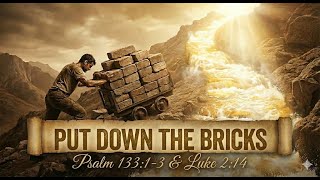
Put Down the Bricks
The Gravity of Grace: Putting Down Your Bricks
Psalms 133:1-3 • Luke 2:14
The Gravity of Grace: Putting Down Your Bricks Do you ever feel like you are endlessly working on a spiritual construction site? We often approach our...
The Descent of Grace: a Comprehensive Exegetical and Theological Synthesis of Psalm 133 and Luke 2:14
Ps 133:1 • Luke 2:14
1. Introduction: The Vertical Architecture of Peace The theological landscape of the Judeo-Christian tradition is frequently characterized by a disti...
Read in Context
Click to see verses in their full context.
Song (Other Languages)