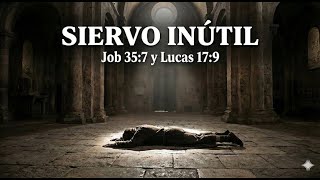
The Willingness to Be a Humble Servant of the Heavenly Father
If you are righteous, what do you give Him, or what does He receive from your hand? — Job 35:7
Does he thank the servant because he did what he was told? — Luke 17:9

Author
Dr. Roberto Miranda
Summary: Our daily relationship with God must spring from humility and obedience. The parable of the servant reminds us that doing what we are commanded does not entitle us to claim recognition: we live to serve the Father. The word “servant” expresses a devotion so complete that we can compare it to that of a slave, subject to the will of his master. This comparison needs qualification, for we are not slaves in every sense; even so, God has full authority over our lives. By acknowledging his lordship and seeking to please and glorify him, we find the disposition needed for a fruitful life and, paradoxically, for our spiritual dignity.
What should our attitude be, and how should we relate to God day by day? What should our self-image be when we relate to the Father, when we live out our life of service to the Lord, and when we do all the things we do within the Kingdom of God?
In the coming meditations, I want to use as a starting point a text found in the Gospel according to Saint John, in chapter 17, beginning with verse 7 through verse 10: a well-known parable of our Lord Jesus Christ.
And the parable says: “Which of you, having a servant who plows or tends livestock, says to him when he returns from the field, ‘Come and sit down at the table’? Does he not rather say to him, ‘Prepare my supper, gird yourself and serve me until I have eaten and drunk, and after that, you eat and drink’? Does he thank the servant because he did what he was commanded? I think not.”
“So you also, when you have done all that you were commanded, say: ‘We are unprofitable servants, for we have done what we ought to have done.’”
This passage invites us to see ourselves as people who are completely subject to the Will of God, people who are wholly at the Father’s service and who consider themselves, ultimately, to have no rights of any kind before God, because God is completely sovereign and He can do whatever He wants with our lives.
And I believe that is what the Lord was trying to instill, to impress upon the minds of the disciples and, by extension, upon our own way of thinking. It is the idea that God has complete rights over our lives and that we must give the Lord that place of absolute privilege; that this posture is essential to the Christian life and is the essential foundation that enables us to have a fruitful life, powerful, lasting, and influential ministries, and to please the Father as we live our lives before Him and carry out our service before Him; that God wants to see this posture of complete humility and complete submission to God’s rights and His absolute Lordship. I believe this is explained and set forth throughout the pages of Scripture.
And in this parable the Lord begins with an illustration of a servant. We must understand that the first key to understanding this passage—and I hope we will develop this further later on—is that word the Lord uses: “servant,” which is a translation into Spanish of the word “doulos,” d-o-u-l-o-s, in the original Greek in which this passage was written. And what the word doulos actually means is “slave.” It was the word used in Greek to refer to that person in the ancient world who belonged to a master, an owner, and had no rights, no personal dignity.
His life was completely subject to his owner’s will. He did not govern himself and did not even have the privilege of deciding whether he would stay with his owner or not, whether he would move somewhere else, whom he would marry, whether he would study or not; none of those decisions that are ordinary for a normal human being belonged to people of this kind, who were slaves in the ancient world. This person was entirely subject to the will of his master and did not govern himself, and before making any decision he first had to consult his owner.
And so what the Lord invites us to understand in this passage is that this is our condition too. Before the sovereignty and utter greatness of the God we serve, we are merely slaves. And later I will qualify that a little, because in another sense we are not slaves, and we will see that later; that is the complexity of this parable.
But what the Lord wants us always to understand is that, yes, at a fundamental level, we must consider ourselves so devoted, so subject to the Will of God, that it is as if we were His slaves. And our spiritual greatness depends specifically on there always being, in our hearts, in our minds, in our subconscious, this recognition: I am a servant of God, I am a slave of God, God has complete rights over my life, He has the power to do whatever He wants with me, and my role in life is to please Him, to live to glorify Him, and my greatness lies in being completely obedient, completely subject to His Will.
When that disposition is present in a believer, many things then become possible, including the dignity of that believer, which, paradoxically, depends on their willingness to be a humble servant of the heavenly Father.
In our next meditation we will continue to develop this thought a little further. God bless you; until our next session, and I hope you will continue with me as we explore this beautiful truth of the Gospel and the Christian life. God bless you all.
What do you think?
What do you think about "The Willingness to Be a Humble Servant of the Heavenly Father"?
Related Content
Unprofitable Servant
The Liberating Truth of Divine Sufficiency and Human Unprofitability
Job 35:7 • Luke 17:9
From the earliest sacrificial cults to contemporary views of faith, humanity has often sought a transactional relationship with the Divine, assuming a...
The Ontological Asymmetry: a Systematic and Exegetical Report on the Interplay of Job 35:7 and Luke 17:9-10
Job 35:7 • Luke 17:9
1. Introduction: The Theological Crisis of Reciprocity The history of religious thought is largely the history of humanity’s attempt to establish a t...
Song (Other Languages)