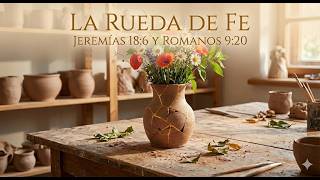
Father, Your Will Be Done, for I Am Merely Your Servant
“O house of Israel, declares the LORD, can I not treat you as this potter treats his clay? Just like clay in the potter’s hand, so are you in My hand, O house of Israel. — Jeremiah 18:6
But who are you, O man, to talk back to God? Shall what is formed say to Him who formed it, “Why did You make me like this?” — Romans 9:20

Author
Dr. Roberto Miranda
Summary: Jesus gave up his privileged status and obeyed the Father even to death on the cross. Because of this humility, God exalted him to the highest place. That same attitude of surrender must govern our lives: before we are lifted up, we must humble ourselves and acknowledge that we owe everything to God. Like clay in the potter’s hands, we are at his disposal; we have no right to demand what we want from him or to grow bitter when he allows trials. We can receive both good things and hardships from his hand and say, “Father, Your will be done.” Christ has already redeemed us, and that is enough for us to surrender fully to his lordship.
The Lord did not cling to His privileged position, but emptied Himself of it and became like a man—and not just any man, but a doulos, a slave of God, of the Father, there to do the Father’s will—and He was obedient. How far did His obedience go?
So far as to go up onto the cross and die the death of a sinner, though He was perfect in all His ways and in His character. That was how far Jesus’ submission, His total surrender to His Father’s will, went. And Paul says: that same attitude must be in each of you as well, an attitude of total surrender to the Lord.
It is also interesting that, in that passage from Philippians chapter 2 that I have just cited, as we have said before, that posture of utter vulnerability, total surrender to the Lord, and complete openness to whatever God wants to do in our lives—which brings us to the point of being almost like slaves of God—is also the starting point for the most extraordinary blessing, for the ennobling of the man and woman of God. Until we humble ourselves to the very depths, we cannot be raised to the summit.
In Philippians chapter 2, after Paul tells us that the Lord became obedient unto death, even death on a cross, notice what he says in verse 9 of Philippians 2: “Therefore God also exalted Him to the highest place and gave Him a name that is above every name, so that at the name of Jesus every knee should bow, of those in heaven and on earth and under the earth, and every tongue confess that Jesus Christ is Lord, to the glory of God the Father.”
We see, then, as we were saying before, that when the Lord humbles Himself to the point of suffering a shameful and terrible death, for that reason it says, “Therefore God”—because He humbled Himself to that point and made Himself a mere slave of God—God exalts Him and gives Him a name above every name. God exalts Him, it says, to the very highest place, to the point that every knee must bow before the majesty and lordship of Christ, and every tongue comes to confess that Jesus Christ is Lord, for the ultimate glory of God the Father.
And that is the same path every child of God must follow. First, total humbling: recognizing that we are nothing before God, that we owe everything to God, that we have no right to demand anything of God or to protest against anything He wants to do in our lives. Because, after all—and this is what we must understand—God can do whatever He pleases with us and within us.
In another passage, Paul says: “Does a potter not have the right to take a lump of clay and, if he does not like the result of a vessel he is making, simply take that vessel and, while the clay is still pliable, turn it back into a lump, and then make another vessel if he wants to?” The answer: obviously, of course he has that right. And Paul says: well, that is what we are like too. We are like vessels in the potter’s hands, and God can do with us whatever He wants.
Many times we also sing that chorus that says: “I want to be, Lord, a lover, like clay in the potter’s hands. Take my life and make it anew. I want to be a new vessel.” We sing that, but we do not understand what we are saying.
That idea rests on the other idea that we are servants entirely at our Lord’s disposal. He has every right over our lives; He can take us through any experience He wants; He has the right to shape us however He wants. And we must never grow bitter toward God because He did not give us something we wanted or gave us something we did not want. Our posture should be like Job’s in the Old Testament. When his children, his wealth, and his health are taken from him, he says: Hey, God gave, God took away; may the name of the Lord be glorified. And he says to his wife: hey, shall we accept only the good things from God and not the bad things? The idea is that we must accept everything that comes from God’s hand.
So this idea of the One who owns our lives, who uses us as He wishes and does not have to give us an account of anything He does, or even thank us for what we do—and that our posture should be: hey, I do everything I do because that is my situation, that is my condition, and God owes me nothing, nor do I have the right to question God or make demands of Him; I am simply an instrument in His hands—when we internalize that attitude and make it the starting point of our whole life and everything we do, when that attitude is the backdrop to our consciousness and our Christian life, it is tremendously powerful, because then it allows God to do everything He wants to do in our lives.
And that is the spirit of all Scripture, and it must be our own spirit as well. Father, let Your will be done in my life. When trials come, when tribulations come, Lord, I am at Your disposal. If that is what You want of me, may Your name be glorified. If I want to live a certain kind of life and, for some reason, it does not come about, though I have prayed to You and asked You, and I do not receive what I wanted, Father, let Your will be done, because I am merely Your servant, merely Your creation, and You have already redeemed me with the precious blood of Jesus Christ, and that is more than enough for me. Everything else is secondary, and I must be wholly surrendered to Your will.
May God grant that this powerful attitude govern our lives; in that attitude there is great dignity and great power. And in our next meditation I will take up one more passage, this time from the apostle James, which invites us, once again, always to bear this in mind: I do not govern myself; God has complete lordship over my life. God bless you, and until our next meditation.
What do you think?
What do you think about "Father, Your Will Be Done, for I Am Merely Your Servant"?
Related Content
The Wheel of Grace
Reshaped for Glory: Embracing the Potter's Will
Jeremiah 18:6 • Romans 9:20
As believers, we find profound insight into God's character and our place in His divine plan through the timeless metaphor of the Potter and the clay....
The Potter and the Clay: an Exhaustive Exegetical and Theological Analysis of the Intertextual Dynamics Between Jeremiah 18:6 and Romans 9:20
Jeremiah 18:6 • Romans 9:20
1. Introduction The metaphor of the potter and the clay constitutes one of the most enduring and evocative images within the Judeo-Christian scriptur...
Read in Context
Click to see verses in their full context.
Song (Other Languages)