A Way Even More Excellent Than Seeking the Gifts
And I will come down and talk with thee there: and I will take of the spirit which is upon thee, and will put it upon them; and they shall bear the burden of the people with thee, that thou bear it not thyself alone. — Numbers 11:17
But covet earnestly the best gifts: and yet shew I unto you a more excellent way. — 1 Corinthians 12:31

Author
Dr. Roberto Miranda
Summary: The gifts of the Holy Spirit are diverse, but they come from the same source and serve the one Body of Christ. Every member of the Church contributes something necessary and deserves equal dignity; therefore, we should appreciate the gifts of others without considering ourselves superior. We should seek the gifts that best serve the purposes of the Kingdom, but the more excellent way is love. Without the character of Christ, even the most powerful manifestations and the greatest sacrifices are of no value. The gifts meet temporary needs; love endures. Let us therefore seek the power of God together with the kindness, patience, and love that make our service fruitful.
First Corinthians chapters 12, 13, and 14 form a unit in the mind of the apostle Paul and in the intentions of the Holy Spirit. But if we read these three chapters, we see that there is a natural progression from one to the next, and that these three chapters concerning the ministry of the Holy Spirit in the life of the Church form a whole that allows us to gain a very balanced and very complete understanding of this important subject.
In chapter 12 of First Corinthians, the apostle Paul establishes the importance of knowing about the gifts. He establishes that the gifts, with all their diversity and manifestations, come from one source and one Spirit, the Holy Spirit. That spirit, if it is of God, acknowledges that Jesus Christ is Lord, that He is the Son of God, that He is the mediator between God and man, and has Jesus Christ, the Father, and the Triune Spirit as its foundation; any other spirit that is not the Spirit that acknowledges Christ as Lord and Savior is not a spirit with which we should have a relationship in any way, and that is why the apostle Paul makes this clear.
And he also warns them to be careful not to fall into the pagan mindset of believing that there are many different spirits, each doing something different, as was the case in Greek and Roman mythology. And then the apostle Paul also turns to the importance of seeing that all these manifestations are like the different organs and members of a body, and that together they form a unity.
And just as there is an indissoluble and inseparable unity among the different organs and members of a body, so too there is an indivisible relationship among the different gifts, and every member of the Church must appreciate the gifts of others. No member should feel as though they are the most special or the most important; they should affirm the others, and there should be a mutual appreciation of the interdependence of the different members of the Church, each with something specific to contribute. The humblest person, the one who cleans the church building or, so to speak, the toilet in the church bathroom, has as much importance and dignity as the pastor who preaches the Sunday sermon, and all are parts of that Body of Christ, working to advance the purposes of God and the Kingdom of God.
And at the end of his presentation in First Corinthians chapter 12, the apostle Paul says something very powerful that then leads us into chapter 13 of First Corinthians. Paul says in verse 31 of chapter 12: “Therefore earnestly desire the better gifts, but I show you a still more excellent way.”
Why does Paul speak of “those better gifts”? Because, yes, every gift is important. But there are some gifts that, as we will see why in chapter 14, are sometimes more useful for the purposes of the Kingdom of God. And so we, as people who want to see the Kingdom of God advance, must be concerned that those gifts be cultivated and ask the Holy Spirit to give us those gifts.
But here he says: You know what? Even beyond the gifts, there is something still more important, and I want to show you that way. What is that better way, the more excellent way that is more important and enduring than the gifts themselves? Chapter 13 gives us the answer. Love.
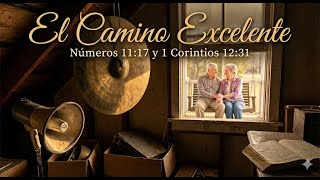
We know that chapter 13 of First Corinthians is that hymn to agape love, love in its most exalted and most beautiful expression, and Paul then begins his praise of love, which is above any gift, and says: “If I spoke in human and angelic tongues, but did not have love, I would become like sounding metal or a clanging cymbal; and if I had prophecy, and understood all mysteries and all knowledge, if I had all faith so that I could move mountains, and do not have love, I am nothing.”
So we see that here Paul begins to establish something very important that those of us who identify with God’s Pentecostal movement must keep in mind amid all the manifestations of the Power of God that may occur in the life of a Church or an individual: the character of Christ, the fruit of the Holy Spirit, must be absolutely central. Without that, the gifts are mere chaff and empty firewood that do not produce the true fire of the life of God.
And that is why Paul uses this illustration, saying: If I had faith, if I had prophecy, if I gave all my money and all my possessions to the poor, but it did not spring from a loving spirit, then it would be of no use. And then Paul continues in chapter 13, speaking of the beauty of love and of how love never fails.
But he says: “Prophecies will come to an end, tongues will cease, and knowledge will come to an end,” because all these things are temporary. All these things are for as long as the Church remains here on Earth, while we live this imperfect existence in which the Kingdom of God is in conflict with the kingdom of darkness, and the gifts, the Power of God, are needed.
But Paul says: A day will come when all that will have passed away and the gifts will no longer be needed. When the gifts are no longer needed, what remains? Only love remains. Paul says in a passage that prophecies will cease, faith will cease, hope will cease, because these things will no longer be necessary; but the only thing that will remain, the greatest of them, he says in verse 13 of chapter 13, is love.
So it is important for us to understand, brothers and sisters, that no matter how anointed a person may be, no matter how productive they may be in the things of the Kingdom of God, everything we do must show the love of Christ. Everything a believer does in life must be characterized by that fruit of the Holy Spirit that Paul describes so well in Galatians chapter 5: that goodness, that kindness, that patience, that joy, that inner peace that comes from being reconciled with God and with ourselves. Everything must be lubricated and saturated with the love of God.
If our lives, our character, do not reflect the character of Jesus Christ, no matter how many gifts we have—and we see that the gifts are important; Paul is not saying that the gifts are unimportant. What he is saying is that there is something still greater and more powerful, which is the love of God, and that the gifts must be bathed in that character of Jesus Christ.
When we, brothers and sisters, have that character of Jesus Christ of which the apostle Paul speaks to us in First Corinthians chapter 13, then the gifts serve a very, very powerful purpose. May the Lord grant that we can always hold those two qualities in sober balance: seeking the Power of God, but also seeking the character of Jesus. That is what truly makes a Christian, a servant of God, effective and brings glory to and pleases the God whom we serve. God bless you, and I hope this will be a blessing in your lives. Amen.
What do you think?
What do you think about "A Way Even More Excellent Than Seeking the Gifts"?
Related Content
The Excellent Way
The Spirit's Unfolding Purpose: Empowering Every Believer for Love and Service
Numbers 11:17 • 1 Corinthians 12:31
The journey of the Holy Spirit, from the ancient wilderness to the early church, reveals a profound transformation in how God empowers His people. Thi...
Pneumatological Continuity and Transformation: an Exhaustive Exegetical Analysis of the Interplay Between Numbers 11:17 and 1 Corinthians 12:31
Numbers 11:17 • 1 Corinthians 12:31
1. Introduction: The Pneumatological Arc from Sinai to Corinth The biblical narrative of the Holy Spirit—conceptually bridging the Hebrew Ruach and t...
Read in Context
Click to see verses in their full context.
Song (Other Languages)